
 It’s a murder mystery fantasy romance with a Christian theme perfect for all ages in the general and Christian markets.
It doesn’t matter how well written your story is if you don’t understand the market. You may have mastered dialogue, showing, and description, but it won’t matter if you can’t get a contract.
One of the top 10 reasons agents reject manuscripts is that the authors don’t understand the market. You can improve your chances of publication by understanding the market and submitting the right manuscripts to the right people.
What Is the Market?
The publishing market is essentially the audience, and it’s split into two groups — the Christian market and the general market. The Christian market is set by the Christian Retailers Association (CRA).
“CRA [Christian Retail Association, formerly CBA] was created to help build community within the Christian retail industry and to bring beneficial assets to store owners and vendors alike. Membership benefits include discount programs, networking, training and education, industry information, best practices and a place to exchange ideas” (https://www.christianretailassociation.org/about).
The American Booksellers Association (ABA) is the CRA equivalent to the general market.
“The American Booksellers Association is a national not-for-profit trade organization that works to help independently owned bookstores grow and succeed.… ABA provides education, information, business products, and services; creates relevant programs; and engages in public policy and industry advocacy. The Association actively supports and defends free speech and the First Amendment rights of all Americans. A volunteer board of 11 booksellers governs the Association” (www.bookweb.org/about-aba).
Basically, the goals of the CRA and ABA are to help publishers and retailers work together to sell more books within their markets.
Why Does This Matter?
The CRA and ABA exist for a reason — readers of CRA fiction and readers of ABA fiction don’t always overlap. They also have specific expectations. If your novel includes a character who drops f-bombs on every other page, don’t expect agents and publishers of Christian fiction to represent and publish it — the Christian market doesn’t print gratuitous swearing. Similarly, if your book includes non-pastor characters openly discussing their faith and proclaiming Jesus as Lord and Savior, don’t expect the general market to accept it.
Are there readers who cross the market divide to read on either side? Sure, but there aren’t enough of those readers that either market will risk alienating their readers by publishing material they know the majority of their audience doesn’t want to read.
That doesn’t stop authors from crossing the market divide in their writing though. They like to refer to The Shack when explaining why they should be able to write across market boundaries. The problem with that example is the statistics don’t support the strategy.
Did The Shack succeed in the general market? Absolutely! But the book was written in 2008. There hasn’t been another crossover success like it since then. In 2022, there were approximately 4 million books published. Let’s guess half of those are fiction. Let’s also suppose the numbers haven’t been that high in the entire 15-year period since The Shack released — let’s be conservative and estimate 500,000 novels a year were published in the first five years, 1 million each in the second five, and 2 million in each of the last five — that’s 17,500,000 new novels since The Shack released, and no crossover book has ever come close to matching its success.
Can you write a crossover book and pitch it to both audiences? Sure, but you have less than a one-in-a-million chance of success.
What About Genres?
Similar to the importance of understanding the CRA and ABA markets is the importance of understanding genre. Well-written, engaging manuscripts are rejected every week because authors don’t understand genres.
In a nutshell, a genre is a promise — when you label your book a specific genre, you’re promising the reader that your story will meet specific genre requirements The main fiction genres (and their requirements) are as follows:
- Romance: A story in which the main plot revolves around the hero and heroine finding each other and falling in love.
- Historical: Any novel set in a recognizable period of history. Stories can occur at any time, from Ancient Greece to World War II. Plots may vary.
- Suspense/Thriller: A story that contains elements of action and peril, often putting the main character(s) in dangerous or suspicious situations. It might include a mystery but that isn’t a requirement.
- Mystery: Exactly what it says — the main character(s) are faced with a mystery or mysterious circumstances that they must solve.
- Contemporary: A novel set in the current era. The plot can involve any number of topics, as long as the main plot is not romance, mystery, or suspense/thriller.
- Speculative: Formerly called science-fiction or fantasy, speculative fiction encompasses both categories. Speculative novels involve some aspect of the fantastic, whether it’s a completely made-up world or elements of the supernatural in the modern world.
- Women’s Fiction: The protagonist is a female, and the plot revolves around her emotional journey. It’s a tale of personal growth and life-changing events. It can involve deep, emotional issues, such as adultery, abuse, or addictions.
- Chick Lit: Similar to women’s fiction, the protagonist is a female who experiences personal growth. Dissimilar to women’s fiction, the events are less serious and sometimes border on superficial.
There are also many subgenres (i.e., romantic suspense, historical thriller, magical realism, etc.) that have their own specific requirements.
There are three main genre issues that prevent writers from signing with agents or publishers.
- Writers submit a genre the agent doesn’t represent. That’s an easy fix. Do your research and send your story to the right agent.
- Writers don’t understand the genre. If the story ends with the hero dying, it’s not a romance. Authors don’t get to define the genre; the market has already done that. Stay within your genre’s guidelines.
- Writers mix too many genres. In fiction, more is less — the more genres you cram into a novel, the smaller your audience (because it will only appeal to the people who read all of those genres). Master the main genres first; then, once you’ve built your fan base, you can add more genre elements.
Understanding these basics about the market will help you craft a story that audiences will enjoy (and that agents and publishers can sell).
 Karin Beery is a published author and editor with experience in traditional and self-publishing, freelance editing, and editing for publishers. She is an active member of Advanced Writers and Speakers Association, Christian Authors Network, and the Christian Proofreaders and Editors Network, as well as a PEN Institute instructor. Her specialty is substantive fiction editing with an emphasis in romance and women’s fiction.
 I recently wrote a feature article about artificial intelligence (AI) and how businesses can use it to their advantage. The inherent trouble with this type of hot topic, however, is that there’s breaking news every day, basically rendering the content obsolete by the time you send it to your editor. In the process of researching the article, I even went straight to the source with questions. (For the record, the AI answers were no more illuminating than anything I found on Google.)
 Jake Poinier made the leap into freelance writing and editing in 1999 after a decade of positions in the publishing industry, giving him key insights from both sides of the desk. As the founder and owner of Boomvang Creative Group, he has worked with a diverse array of Fortune 500 and small businesses, consumer and trade magazines, and independent authors. Jake is committed to helping freelancers improve their businesses and shares his knowledge and experiences frequently as a speaker at industry conferences, through webinars, and on his blog.
 Amy Waters Yarsinske is the author of several best-selling, award-winning nonfiction books, published regionally, nationally, and internationally. Amy’s proposal technique was featured in literary agent/author Peter Rubie’s Telling the Story: How to Write and Sell Narrative Nonfiction; she also did a National Press Club panel with Rubie during the No One Left Behind press tour. She has been a regular contributor with international, national, and regional media, to include continued guest spots on national radio. An American in the Basement: The Betrayal of Captain Scott Speicher and the Cover-up of His Death won the Next Generation Indie Book Award for General Non-fiction in 2014, and No One Left Behind: The Lt. Comdr. Michael Scott Speicher Story earned her literary awards, an incredible press tour, and national/international recognition. With over 30 years in the publishing industry, Amy has published over 85 nonfiction books, most of them spotlighting current affairs, the military, history and the environment with a few biographies and corporate histories interspersed. Amy graduated from Randolph-Macon Woman’s College in Lynchburg, Virginia, where she earned her bachelor of arts in English and economics and the University of Virginia School of Architecture, where she earned her Master of Planning and was a DuPont Fellow and Lawn/Range resident.
 Ah, networking — an eternal topic for independent writers and editors.
 Ruth Thaler-Carter has been a full-time freelance writer, editor, proofreader, desktop publisher, and speaker for more than 30 years. She has been published locally, regionally, nationally, and internationally in, and does writing, editing, and proofreading for, publications, associations, nonprofits, websites, service firms, independent authors, and businesses. She sold her first freelance articles when she was still in high school. Often called the Queen of Networking, Ruth is active in about a dozen professional associations, serving as a newsletter editor, webmaster, publication author, speaker/presenter, blogger, program host or planner, and chapter leader. In 2006, Ruth launched the Communication Central Be a Better Freelancer annual conference, now cohosted with NAIWE — to help aspiring and established freelancers find greater success. Ruth is also owner and editor-in-chief of the An American Editor blog and owner of the A Flair for Writing publishing business. Her honors include member of her high school alumni hall of fame, in part for her publishing work and networking services; Writers and Books Big Pencil Award for teaching adults and contributions to the literary community; EFfie awards for writing, editing, and newsletters; an APEX award for feature writing; the Philip M. Stern Award of Washington (DC) Independent Writers for service to freelancers; and IABC/DC Communicator of the Year and Silver Quills for magazine writing and newsletters.
 Growing up in a minuscule town in eastern Kentucky, I was a good student, a teacher’s pet, and a bookworm.
 John Early McIntyre has been a professional editor for nearly 40 years, more than 31 of them at The Baltimore Sun, where he has headed the copy desk. John earned an undergraduate degree in English from Michigan State University, where he was elected to Phi Beta Kappa, and a master’s degree in English from Syracuse University, where he was a university fellow. John has taught copyediting at Loyola University Maryland since 1995. A charter member of the ACES: The Society for Editing, he served two terms as its president. John has presented workshops on writing and editing at conferences and publications in the United States and Canada.
 Laura Pennington Briggs is the founder and CEO of the Freelance Coach. A two-time TEDx speaker on how freelancing is changing the economy and the host of the weekly Advanced Freelancing podcast, Laura has helped over 15,000 freelancers start and scale their business. She’s an expert on systems, project and client management, marketing a solopreneur business, delegating to team members, retainers, and developing multiple income streams for writers of all stripes. Laura is the author of five books, including the Six Figure Freelancer and How to Start Your Own Freelance Writing Business. She’s also the founder of Operation Freelance, a national nonprofit providing free entrepreneurship training to military spouses worldwide.
 After landing on the moon . . . that could have been a fun location for a murder.
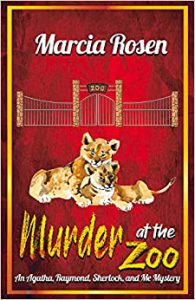
 Marcia Rosen (aka M. Glenda Rosen) is an award-winning author of eleven books including her newest one, An Agatha, Raymond, Sherlock and Me Mystery: Murder at the Zoo plus The Senior Sleuths, Dying To Be Beautiful Mystery Series, and The Gourmet Gangster: Mysteries and Menus (menus by her son Jory Rosen). She is also author of The Woman’s Business Therapist and award-winning My Memoir Workbook. For 25 years, she was owner of a successful national marketing and public relations agency. Marcia has frequently been a speaker or program moderator at organization meetings and conferences, bookstores, libraries, and Zoom programs. Topics she has taught and presented over the past twenty years include Encouraging the Writer Within You, Marketing for Authors, Writing Mysteries…Not A Mystery, Writing Your Memoir, and recently Anatomy of Writing a Murder. Many articles on these topics have been published on mystery reader blogs and in newsletters and magazines and her newest articles relating include Location, Location, Location: Murders Have Their Places; Hearing Voices of Past Famous Detectives: Their Impact and Influences; and Writing Mysteries at a Zoo: With Caution. She is a member of Sisters in Crime National and New Mexico (Croak & Dagger), Southwest Writers, New Mexico Book Association, Women Writing the West, Public Safety Writer’s Association, Women’s National Book Association, and National Association of Independent Writers and Editors.
 On Monday, The Baltimore Sun won the Pulitzer Prize for local reporting.
 I read a book that says writers can — and even should — write just about anywhere and everywhere. We should write in cafes, restaurants, and coffee shops; on buses, boats, trains, and planes; and where beauty surrounds us in museums, art galleries, and places of worship.
 New Mexico is a land of amazing sunrises and sunsets with a sky constantly changing colors and forms, mountains framing the background, and a desert that stretches across the mesa often giving the land a mystical feeling. Known as the land of enchantment, it still has its share of mysteries, ancient and new. As a mystery writer, I find it intriguing and exciting to involve this land as an important character in my new mystery. Place is often as important a character as the people in a novel.