Member's Library I am what the librarians have made me . . . B. K. Sandwell
  • About
    • About NAIWE
    • Board of Experts
    • Books Published by NAIWE Experts
    • FAQs
    • Advertising
  • Member’s Area
    • Member’s Library
    • Member Website Development
    • Benefit Links and Passcodes
    • Manage Your Account
    • The Member’s Edge
    • NAIWE Media
    • On-Demand Training (Discount)
  • Training
    • Upcoming Webinars
    • On-Demand Training (Discount)
  • Find a Professional
  • News & Events
    • Blog
    • The Edge
    • The Member’s Edge
    • The Edge Writers Guidelines
    • Conference
    • Podcasts
    • Summer Challenge
    • Words Matter
      • Words Matter Week
      • How to Participate
      • Media
  • Post a Job
  • Contact
  • Member Sites

The Importance of Being Visible

Friday, February Post a comment

One of the common pieces of wisdom that always floats around the freelance-o-sphere is that you should always be marketing. Market when you’re slow, market when you’re busy, market when you’re in Goldilocks territory. But let’s be real: Do you really feel like doing that when you’re swamped with multiple deadlines during a 60-hour week?

I sure don’t.

The key is to be as visible as possible to potential clients when you’re not actively marketing, while being prepared to ramp up when you need to put in the effort.

At the risk of stating the obvious, the foundation of everyday visibility starts with a well-designed website with all of your contact information, as well as a comprehensive, professional-looking profile on LinkedIn. Depending on the professional associations you belong to (such as NAIWE!), you might have several locations where you can put your skills and experience into the public sphere.

But then what? Alas, just because you’ve done the basics doesn’t guarantee anything is going to appear in your inbox. When you’ve got the time and energy, where should you apply your efforts? When I’m looking at my calendar and seeing an upcoming gap, these are my go-to strategies to ramp up my visibility:

  • Reach out to existing clients. As a rule, I use any excuse I can to make contact with the people I already have good relationships with. Every time I get a payment, I send a personal, handwritten thank-you note. I also send a note when I receive a referral. If I see a story on the web that might be of personal or professional interest, I’ll forward it. (The website Help A Reporter Out [https://www.helpareporter.com] is a terrific excuse to contact a client who has expertise in a given topic.) In any case, it’s amazing how often those small gestures will generate an email or a phone call.
  • Reconnect with older contacts. I keep a folder named “dormant” on my computer, where I move old client jobs after a year or so of inactivity. Not all of them are people I’d want to work with again—but for the ones who are, it’s a matter of sending a quick note to reopen the lines of communication. Maybe I saw something about their company in the news or heard about a trend in their industry. If they’re in town, I’ll offer to buy them a cup of coffee or lunch as a chance to catch up.
  • Play rolodex roulette. In addition to being part of the everyday visibility part of the equation, LinkedIn is a treasure trove of past coworkers, many of whom have moved into positions where they might want to hire you. (If nothing else, it’s a good excuse to swap stories about the good ol’ days.)
  • Tap connections in my mastermind group. This is a long-term investment in my business, being part of a diverse group of businesspeople that meets once a month. We don’t directly solicit business from each other, but we’re open and honest about how our businesses are doing—and we’re all interested in helping each other succeed.
  • Dial up my cold-contact activity. Finally, I’ll spend a few minutes each day researching categories of businesses that I have the best success with, such as graphic designers, web designers, and trade publications. Then it’s a matter of crafting targeted emails to connect and see if we might partner.

None of these steps are difficult, painful, or expensive, and all of them have a much better likelihood of producing a decent project than trolling through a bunch of bidding sites. It hardly even feels like marketing if you’re authentic about why you’re contacting someone.

Jake Poinier made the leap into freelance writing and editing in 1999 after a decade of positions in the publishing industry, giving him key insights from both sides of the desk. As the founder and owner of Boomvang Creative Group, he has worked with a diverse array of Fortune 500 and small businesses, consumer and trade magazines, and independent authors. Jake is committed to helping freelancers improve their businesses and shares his knowledge and experiences frequently as a speaker at industry conferences, through webinars, and on his blog.

Categories: Jake Poinier, Marketing

7 Headline Tweaks That Attract Readers to Your Personal Blog

Tuesday, January Post a comment

It’s the dream of many writers—you create a personal blog on a passion topic. Then, you use that blog as a writing sample that helps get you hired for freelance-writing jobs.

Many writers have a blog on their writer website—maybe you’ve got one here on your NAIWE website? The hope is that the blog posts will help you attract clients. Right?

The only problem is, most personal blogs fail to draw the paying clients. And the top reason they fail is the blog-post headlines.

Most post headlines are . . . let’s say . . . not exactly fascinating, which is why most personal blogs have zero comments and zero retweets, too. There are other issues with headlines that keep readers from finding your content, too.

For your personal blog to get you freelance clients, that blog needs to have what marketers call engagement—posts need to get comments and social shares.

If you want blogging clients—or even harbor dreams of monetizing that personal blog—you’ve got to understand how to write amazing headlines that make people simply have to click and read your post.

Luckily, there are simple steps you can take to improve your headlines and turn them into attention-getters that attract clients.


  1. Study Three Little Letters

If you haven’t learned about search engine optimization (SEO) and using keywords to get traffic yet, it’s time. Because post headlines that lack a keyword phrase that helps Google identify and send you interested readers are a complete waste of your time.

Seriously. Don’t even bother writing. Nobody clicks, nobody reads.

What do I mean? Headlines like:

  • “Beware the Red Flags”
  • “It’s About Time”
  • “Biodiversity: It Takes All Kinds”

There are no keyword phrases in the above headlines.

Single-word topic keywords like “biodiversity” don’t get the job done because they’re too difficult to rank. “Threats to Biodiversity” gets 8,000 searches a month, my search tool tells me, and competition for that phrase is relatively low. That’s the sort of keyword phrase you’ll want to use in your headlines.

Get a viable keyword phrase into your post headline, and Google could send you a torrent of new readers.


  1. Use Mystery Sparingly

As you saw above, many blog-post headlines keep readers completely in the dark about what the post covers. That’s not a good thing. Few people are going to click to investigate what this might be about.

However, a little mystery—where we know most of what’s going on, but there’s one unknown or hidden aspect—can be great. For instance, a popular post on my blog is “How I Became a More Productive Writer by Doing This One, Simple Thing.”

This is a known-unknown structure. There’s a topic the reader can identify as something they know about (writing), followed by a mystery item—one thing we don’t yet know. That formula equals: I gotta click.


  1. Promise a Benefit

Most blog post headlines fail because they don’t show what the reader would get out of reading the post. There needs to be some benefit to the reader.

Remember the old WIIFM acronym. Readers are asking, ‘What’s in it for me?” as they scan Google and contemplate reading your post.

Your post headline needs to provide an answer.

A headline like “Threats to Biodiversity” fails this step, because it doesn’t communicate what I might learn that I could use in my life—how I could actually help the situation. I mean, I already know there are threats to biodiversity. Right?

By contrast, a headline like: “3 Threats to Biodiversity You Can Prevent Today.”

Now, that sounds like it has information I could take action on. And I want to read it.


  1. Identify with the Reader

If you can include the reader in your post headline, it helps to attract the right readers. For instance, going back to “How I Became a More Productive Writer by Doing This One, Simple Thing,” you can immediately see it is a post for writers.

It’s not for housewives who want to do chores more efficiently or business executives who want to manage workers more productively; it’s for writers. When people see themselves in the blog-post headline, they tend to get interested.


  1. Don’t Go All In

Many post headlines don’t get clicks because the reader learns what they need to know in the headline. There’s no need to read further. That’s a big problem.

I call these “all in” headlines because everything I need to know is all in the headline.

You don’t want this: “The Border Wall is Just Wrong.”

The reader goes, “OK, I get it. You don’t think we should build the border wall. Done. I agree (or don’t). Got ya.”

Instead, if your headline is: “7 Little-Known Reasons the Border Wall Is Just Wrong”

Now, I might be curious to read what your reasons are. Feels like I might learn something that might affect how I should vote.


  1. Not a Long Story

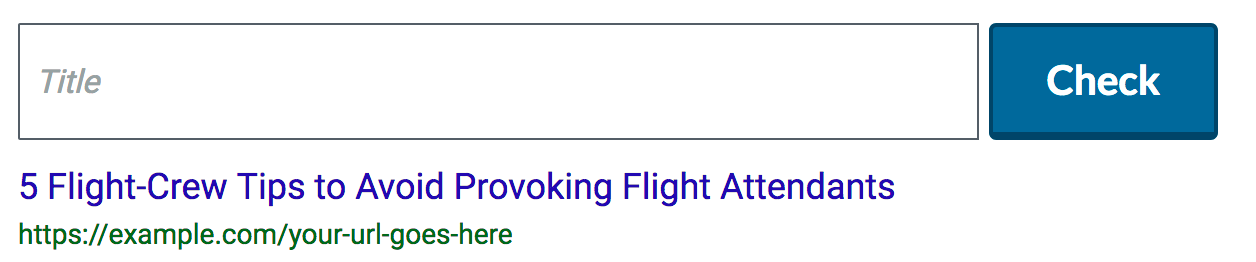
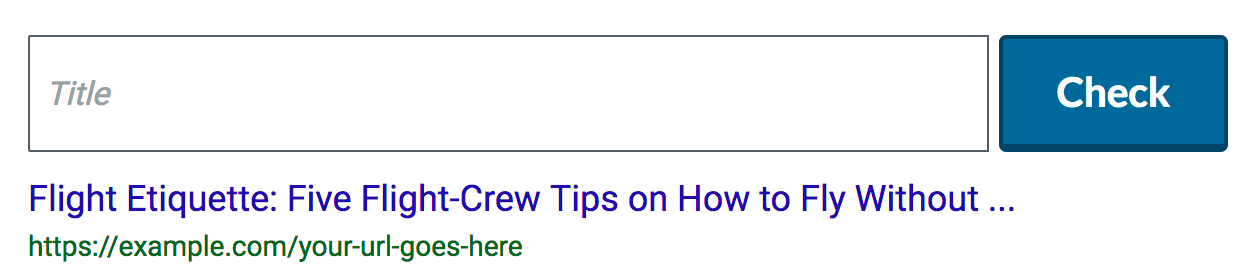
These days, blog post headlines need to be pretty concise. That’s because you don’t want them to get cut off midway in Google search results. Cutoff headlines tend to get fewer clicks. You want your whole headline to show up.

And yes, you should use a tool to check whether your headline (a/k/a ‘title tag’) is too long, if your blog software doesn’t show you character counts. I like the tool from Moz.

In other words, “5 Flight-Crew Tips to Avoid Provoking Flight Attendants,” which as you can see in the checker tool, displays in full on Google.

Not this: “Flight Etiquette: Five Flight-Crew Tips on How to Fly Without Provoking Your Flight Attendant.” As you can see below, that gets truncated in a Google search result:

The drift is lost without the end of the headline, likely resulting in far fewer clicks.

Of course, I checked to make sure the headline of this blog post wasn’t too long, as well:

Creating more concise blog-post headlines is a great habit to get into, even if it doesn’t matter for search because blog posts should be narrowly focused. If you can’t write a concise headline about the topic, you probably don’t have your thoughts organized well enough yet to write the piece.


  1. Make Blog Posts Easy to Write

Do you struggle with writing your posts? If so, here’s a tip: Write the headline first.

Too many bloggers write rambling screeds, planning to figure out the headline at the end. That means they’re free to wander off-topic.

Save yourself a lot of rewriting, and work on your headline first. Remember that your first headline idea is probably not your best one—and keep improving until you love the result.


Use Your Personal Blog to Get Clients

By writing stronger headlines, you’ll attract more new readers. Those focused headlines with keyword phrases in them will draw people interested in your topic—and hopefully, some will comment and share your post on social media.

Next thing you know, prospective clients may be checking out your blog and seeing it’s a busy place. Then, they’ll want to hire you to make that happen on their business blog.


Carol Tice is a freelance writer who focuses on writing and ghostwriting business books and e-books. She’s written for Delta Sky, Forbes, Entrepreneur, Seattle Magazine, Costco, American Express, Shopify, Freshbooks, and many others. Carol founded the award-winning Make a Living Writing blog in 2008, which has been repeatedly named to Writer’s Digest’s Top 101 Blogs for Writers list. It now offers over 1,000 free posts on how to break in and grow your writing income. Her Freelance Writers Den learning and support community was founded in 2011 and has over 1,000 members. Carol has taught over 20 online courses and self-published 10+ e-book titles for freelance writers. She’s also the author/coauthor of two traditionally published business books for entrepreneurs.


Categories: Carol Tice, Headlines

  • « Previous Page
  • 1
  • …
  • 24
  • 25
  • 26

Recent Posts

  • Beyond Writing: How Expanding Your Services Can Strengthen Your Freelance Business
  • Am I a Writer or Not?
  • Be Prepared for That Crisis Moment When You Need Business Backup
  • Stick with Your System
  • In a Pricing Rut? Try These 3 Strategies

Categories

Meta

  • Log in
  • Entries feed
  • Comments feed
  • WordPress.org

Latest Posts

Beyond Writing: How Expanding Your Services Can Strengthen Your Freelance Business

July 22, 2026

Am I a Writer or Not?

July 16, 2026

Be Prepared for That Crisis Moment When You Need Business Backup

June 30, 2026

Stick with Your System

June 29, 2026

In a Pricing Rut? Try These 3 Strategies

June 25, 2026

Improving Your Vision

June 24, 2026

Contact Us

  • 804-476-4484
  • P.O. Box 412
    Montpelier, VA 23192-0412
Facebook Instagram Linkedin twitter

© NAIWE. All rights reserved. Designed by My House of Design.