
Member's Library I am what the librarians have made me . . . B. K. Sandwell
  • About
    • About NAIWE
    • Board of Experts
    • Books Published by NAIWE Experts
    • FAQs
    • Advertising
  • Member’s Area
    • Member’s Library
    • Member Website Development
    • Benefit Links and Passcodes
    • Manage Your Account
    • The Member’s Edge
    • NAIWE Media
    • On-Demand Training (Discount)
  • Training
    • Upcoming Webinars
    • On-Demand Training (Discount)
  • Find a Professional
  • News & Events
    • Blog
    • The Edge
    • The Member’s Edge
    • The Edge Writers Guidelines
    • Conference
    • Podcasts
    • Summer Challenge
    • Words Matter
      • Words Matter Week
      • How to Participate
      • Media
  • Post a Job
  • Contact
  • Member Sites

How to Use a Planner to Put Authors and Editors on the Same Page

Sunday, May Post a comment

Through a blog post, I recently asked what worries nonfiction authors about the editing process. The insights gained can be helpful to any editor as well as the authors they work with.

I received the following array of answers from 40 authors who responded. Specifically, they want:

  • more than a clean up; they want a major step up in clarity
  • support in thinking through the book’s organization before nitty-gritty editing begins
  • their book editor to be tuned in to their objectives for the book, keeping them top-of-mind throughout the process
  • their points made more succinctly and artistically and their stories told well.

As one author said, “An unedited piece can make my point but in a less elegant way than one that’s been edited.”

From the first contact with a client, I open a dialog through what I call a Planner—a questionnaire that focuses on the long-term goals for the book itself. Questions not only address the mechanics of editing but emphasize the author’s big-picture dreams. A few are:

  1. What successful books would be good models for yours?
  2. After people in your target audience have read this book, what do you want them to say about it? How would you like a testimonial to read?
  3. What actions do you want readers to take as a result of reading your book—both for their own benefit and for yours?
  4. What changes do you want to create in your life/business as a result of putting this book out into the world?
  5. Which results do you seek most in working with an editor (followed by a list for ranking)?


Barbara McNichol is a nonfiction editor, who works with authors, speakers, and business professionals to add power to their pen through the written word. Barbara wrote Word Trippers: The Ultimate Source for Choosing the Perfect Word When It Really Matters. She offers helpful writing tips weekly and a course to take your writing and editing to the next level: “WordShops: Strengthen Everything You Write.”

Categories: Barbara McNichol, Editorial Services, Writing

Word Choice: When to Use “Like” vs. “Such As”

Sunday, May Post a comment

When it comes to word choices and deciding what to use in your writing, check out these phrases from a book I’m editing:

. . . the answers that so-called geniuses like/such as Newton seem to embody.

. . . centuries of innovations like/such as the airplane and the space shuttle have resulted.

Here’s why “such as” is preferred instead of “like” in these phrases: The word “like” implies comparison while “such as” implies inclusion. Thus, being like something doesn’t include the thing itself. If the sentence was “they’re like a fish trying to swim upstream,” then it’s a clear comparison.

Let’s examine this more closely. In the first phrase, the author does include Newton as a so-called genius, so “such as” is the better choice. Similarly, in the second phrase, the airplane and space shuttle are examples of innovations, so they’re meant to be included.

Do you see how your intended meaning within the context of your writing helps you choose which word to use?

Your challenge: When you’re about to write “like,” ask this question: Would I include this point in a list or exclude it? That’s your clue on selecting “like” (exclude) or “such as” (include).


Barbara McNichol is a nonfiction editor, who works with authors, speakers, and business professionals to add power to their pen through the written word. Barbara wrote Word Trippers: The Ultimate Source for Choosing the Perfect Word When It Really Matters. She offers helpful writing tips weekly and a course to take your writing and editing to the next level: “WordShops: Strengthen Everything You Write.”

Categories: Barbara McNichol, Editorial Services, Writing

Word Tripper: Breach vs. Breech

Sunday, May Post a comment

Every practice has its tricks of the trade. In this week’s Word Tripper, the trick to knowing the difference between the homonym “breach” and “breech” is this: “Breach,” meaning to open by force or break an agreement, is spelled with an “ea” like the word “break” itself.

If writing is part of your trade, use this trick to differentiate between these two words both in meaning and spelling. Happy Word Tripping!

Breach, breech – As a noun, “breach” is a failure to do what’s required or promised; a break in friendly relations between people or groups; a hole or opening in something created by force. As a verb, it means to fail to do what’s required or promised; to force an opening or break an agreement. “Breech,” a noun, refers to the hind end of something. For example, a breech birth occurs when an infant’s bottom comes out first during delivery. “Breech” is also the part of a firearm (e.g., a rifle or cannon) found at the rear end of its barrel.

“It’s clearly a breech birth when the doctor sees the newborn’s bottom breach the birth canal.” – Dr. Ron Minson


Barbara McNichol is a nonfiction editor, who works with authors, speakers, and business professionals to add power to their pen through the written word. Barbara wrote Word Trippers: The Ultimate Source for Choosing the Perfect Word When It Really Matters. She offers helpful writing tips weekly and a course to take your writing and editing to the next level: “WordShops: Strengthen Everything You Write.”

Categories: Barbara McNichol, Editorial Services, Writing

Telling Your Own Story: Expressing the Emotional “Why” Behind Your Book

Sunday, May Post a comment

Five Reasons to Tell Stories

  1. To ensure what you have to say rings true universally—and that happens when you’re able to craft your story from a deeper place in your being
  2. To get the opposite of calm—you add peaks and valleys, waves and storms into the writing so the manuscript isn’t boring!
  3. To connect us as human beings—our common experience. Stories of the way we work together or live together. Things we experience together, whether that’s dealing with something big like an illness or celebratory like having a baby.
  4. To communicate our values—this is what matters to me. How we made a difference in someone’s life, walking 15 miles in the snow to get to school.
  5. To share a message, make a point—the moral of the story. Stories that provide hope or encouragement, you can do it—not giving up on a goal.


Story Sparkers

If you’re stuck on coming up with a great idea for a personal story, ask yourself these questions first:

  • Why did you write that very book you wrote or the one you’re writing now?
  • What gives you a sense of satisfaction about the book and its subject matter?
  • What inspires you every day?
  • What do you feel most proud of as you wrote this book?
  • How do you know or imagine your book making a positive difference in someone else’s life?
  • What is a treasured moment you carry in your pocket right now that could be turned in a meaningful story?
  • Have you ever been badly hurt?
  • Have you ever been scared?
  • Have you ever laughed so hard you fell out of your chair or peed in your pants?
  • How did you learn to swim?
  • Did you ever play a practical joke? Have you ever had one played on you?
  • Have you ever done something you are proud of?
  • Have you ever been to a dangerous area?
  • When were you in a lot of trouble?
  • Who do you think of when you say, “That person just drives me nuts! Why?


Elements of the Story Arc

  • Set the scene
  • Describe the characters
  • Describe what happens/climax/series of events
  • Resolve the problem
  • Make a point that can apply to reader/listener


Barbara McNichol is a nonfiction editor, who works with authors, speakers, and business professionals to add power to their pen through the written word. Barbara wrote Word Trippers: The Ultimate Source for Choosing the Perfect Word When It Really Matters. She offers helpful writing tips weekly and a course to take your writing and editing to the next level: “WordShops: Strengthen Everything You Write.”

Categories: Barbara McNichol, Writing

Should It Be One Word or Two?

Thursday, May Post a comment

As I was finalizing a manuscript I edited for a nonfiction author, I hired a proofreader to give it a final check. (I knew I’d read it too many times myself.) What she found humbled me. I thought I had a good handle on which words are customarily two words versus one (backyard—not back yard—comes to mind) but several surprised me.

My proofreader corrected these (verified on dictionary.com). Look familiar?

  • rooflines (not roof lines)
  • safe-deposit box (not safe deposit box)
  • old-timers (not old timers)
  • carsick (not car sick)
  • safekeeping (not safe keeping)
  • autopilot (not auto pilot)
  • pocketknife (not pocket-knife)


Barbara McNichol is a nonfiction editor, who works with authors, speakers, and business professionals to add power to their pen through the written word. Barbara wrote Word Trippers: The Ultimate Source for Choosing the Perfect Word When It Really Matters. She offers helpful writing tips weekly and a course to take your writing and editing to the next level: “WordShops: Strengthen Everything You Write.”

Categories: Barbara McNichol, Editorial Services, Writing

Why Book Titles Matter

Tuesday, April Post a comment

Today more than ever, the title of a book (and its cover) can have a bigger effect on the success of a book (or a brand) than almost anything else. In some cases, savvy publishers do little more than give an existing book a new title/subtitle with an improved book cover to give a book a sales boost.

A bestseller starts with a good title!

Your title should:

  • Be easy to remember (1–2-word titles work best!).
  • Have an immediate effect; think about the titles that stopped you (or made you click).
  • Appeal to your target reader (in your niche, the more specific, the better).
  • Have a good subtitle that reveals what the book is about in as few words as possible.

How many books have you picked up simply because of a title that grabbed your attention?

Spend some time on publisher websites and see which titles grab your attention.

How do you get a good review? Put your book in the hands of the right reader. How do you get a bad review? Put your book in the hands of the wrong reader.

An accurate and descriptive subtitle will help get your book in the hands of the right reader.

Examples and ideas…


Fiction

  • The Orphan Collector: A Heroic Novel of Survival During the 1918 Influenza Pandemic
  • The Secrets We Keep: A Gripping Emotional Page Turner
  • The Storm: A Story Inspired by Reincarnation in the Golden Era of Film and Music
  • Into the Darkest Day: An Emotional and Totally Gripping WW2 Historical Novel
  • The Pursuit of the Pankera: A Parallel Novel About Parallel Universes


Non-Fiction

  • The Year of Less: How I Stopped Shopping, Gave Away My Belongings, and Discovered Life Is Worth More Than Anything You Can Buy in a Store
  • The Good Karma Diet: Eat Gently, Feel Amazing, Age in Slow Motion
  • Out Earn: How to Earn More than Your Parents!
  • Earn the A. Get to College. Get well paid.
  • The ABCs to getting A’s: The Proven Path to Better Grades with the Power Learning System
  • The 7 Habits of Highly Effective People: Powerful Lessons in Personal Change
  • The 5 Love Languages: The Secret to Love That Lasts
  • You are a Badass: How to Stop Doubting Your Greatness and Start Living an Awesome Life
  • A Whole New Mind: Why Right-Brainers Will Rule the Future
  • The Happiness Advantage: How a Positive Brain Fuels Success in Work and Life
  • Goddesses Never Age: The Secret Prescription for Radiance, Vitality, and Well-Being
  • Delivering Happiness: A Path to Profits, Passion, and Purpose
  • Tears to Triumph: The Spiritual Journey from Suffering to Enlightenment
  • Anxious for Nothing: Finding Calm in a Chaotic World
  • Dying to Be Me: My Journey from Cancer to Near Death to True Healing
  • Eat Dirt: Why Leaky Gut May Be the Root Cause of Your Health Problems and 5 Surprising Steps to Cure It
  • Dealing with People You Can’t Stand: How to Bring Out the Best in People at Their Worst
  • What Color Is Your Parachute? A Practical Manual for Job-Hunters and Career-Changers
  • The Total Money Makeover: A Proven Plan for Financial Fitness
  • The Life-Changing Magic of Tidying Up: The Japanese Art of Decluttering and Organizing
  • Salt, Fat, Acid, Heat: Mastering the Elements of Good Cooking
  • Start with Why: How Great Leaders Inspire Everyone to Take Action
  • GUTS ’N GUNSHIPS: What it was Really Like to Fly Combat Helicopters in Vietnam


A trend I have seen—like it or not—is piggy backing on the success of an existing title that already has captured people’s attention and getting that word of mouth we all need. It may also help your book show up in Amazon search results better (although Amazon works hard to penalize authors who are gaming the system).

I first noticed it when someone published 50 Shades of Kale. Dozens of authors jumped on the The Fine Art of Not Giving a F*#K bandwagon. And now I’m seeing it with The Life Changing Magic…. Consumers are click happy, and it’s sad to say that many of the sales these authors are getting might be the result of mistaken identity.


Authorpreneur Brian Schwartz is the creator of the award-winning 50 Interviews series. More than 500 authors have trusted Brian and his team to publish their work. The mission of Brian’s practice is “to bridge the gap between self-publishers and traditional publishing by applying the proven strategies and techniques of successful independent publishers.” To meet this objective, Brian launched AuthorDock in 2016 to provide authors an all-in-one secure portfolio management tool to manage deadlines, extended teams, and critical resources. Brian is also the developer of PubWriter, a click-to-publish publishing platform used by authors to create their own web hubs for publishing, promotion, and sales.

Categories: Book Marketing, Brian Schwartz, Writing

How Networking Can Help a Writing Business Get off to a Good Start

Wednesday, April Post a comment

A lot goes into launching a successful writing business, and networking can be one factor in that success. This post focuses on the networking aspect of your writing work.

Writers might not think of networking as an element of their new businesses, and that could mean losing out on valuable ways to learn about the craft and business and to develop connections that could not only improve those aspects of what they want to do, but also to lead to a greater likelihood of getting published.

All writers probably share a common goal: for our words, thoughts, and perspectives to find audiences and outlets. Individuals might be at different stages of creativity, visibility, or success, but every writer wants—even needs—to be seen and heard. For the new writer, that first sale or outlet is so exciting, and networking is one way to get there.

Whether you’re writing a novel or a press release, a poem or a white paper, a play or a case study, a how-to book or a personal blog post, you want what you write to be seen and appreciated. Beyond being seen, we also want everyone who sees our writing to understand it, respond to it positively by publishing reviews or acting on it somehow, recommending it to others, and reading or buying the next piece we write. Networking can help that happen.

Where networking comes into play is in providing resources for learning to write better by joining critique groups, taking classes, or lining up beta readers; identifying reputable editors and proofreaders and understanding and managing their input; finding appropriate agents and publishers for our work; getting paid; and related details of a writing business or the writing life.

Through networking, you can meet colleagues who will provide advice, insights, and resources, and who might become beta readers or refer you to prospective clients and their writing projects. You could be seen by and connect with potential agents to represent your work or publishers who might consider bringing you into their houses, saving you the effort of searching for the ideal agent and outlet. If you plan to self-publish work that needs illustrations, networking can help you find the artist you need.

It’s important to remember that networking is a two-way process. In fact, that might be the most important aspect of networking. A writer needs to create a net of contacts and colleagues who can help them do their work better and enhance their likelihood of publication. One of the best ways to do that is to be a useful strand in the nets of colleagues. Ask questions and look for ways to provide answers to other people’s questions.

And don’t let being new to writing or networking make you feel that you can’t contribute to the networking process. You can! If you don’t have any answers yet, look for resources you can share—books, courses, blogs, organizations, etc.—that you have found useful or have seen in your real-world and online visiting. Keep in mind that we all had to start somewhere, first by actually writing something, next by getting it published, and then by becoming visible and active in some corner of the writing world. Even extroverts like me had to learn the ropes of networking effectively; it isn’t just a matter of paying dues and showing up or using the resources of an association to enhance our own writing work.

In the continuing pandemic era, we can’t do much networking in person, so the introverts among us don’t have to worry as much about fitting in at events as in the past (and, we hope, the future). Nowadays, you can use the virtual world to your networking advantage by “lurking” in online communities and professional associations while taking the temperature of the environment and deciding whether they will be helpful before you spend money on a membership or speak up with your questions and suggestions. Oh, and the membership dues are tax deductible!

Learn and profit from networking, and try to give as much as you take. Your writing business and efforts will blossom as a result, along with your reputation.


Ruth Thaler-Carter has been a full-time freelance writer, editor, proofreader, and desktop publisher for more than 30 years. She has been published locally, regionally, nationally, and internationally in, and does writing, editing and proofreading for, publications, associations, nonprofits, websites, service firms, and businesses. She sold her first freelance articles when she was still in high school. Renowned as a skilled networker, Ruth is active in about a dozen professional associations, serving as a newsletter editor, webmaster, publication author, speaker/presenter, blogger, program host or planner, and chapter leader. In 2006, Ruth launched the Communication Central “Be a Better Freelancer” annual conference to help aspiring and established freelancers find greater success and connections with colleagues. Ruth is the owner and editor-in-chief of the An American Editor blog and received the Philip M. Stern Award of Washington (DC) Independent Writers for service to freelancers; the Writers and Books Big Pencil Award for teaching adults and contributions to the literary community; EFfie awards for writing, editing, and newsletters; and the APEX award for feature writing. She was also an IABC/DC Communicator of the Year.
Categories: Business, Freelancing, Networking, Ruth Thaler-Carter, Writing

Word Tripper: Benevolent vs. Beneficent

Sunday, April Post a comment

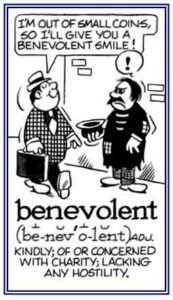
The Random Acts of Kindness Foundation is a non-profit organization that inspires a culture of kindness in schools, homes, and communities. It encourages acts of kindness by providing resources to people who are both benevolent and beneficent.

This week’s Word Tripper clarifies the difference between these similar words.


Image Source: http://wordinfo.info/unit/293/page:2


Barbara McNichol is a nonfiction editor, who works with authors, speakers, and business professionals to add power to their pen through the written word. Barbara wrote Word Trippers: The Ultimate Source for Choosing the Perfect Word When It Really Matters. She offers helpful writing tips weekly and a course to take your writing and editing to the next level: “WordShops: Strengthen Everything You Write.”

Categories: Barbara McNichol, Editorial Services, Writing

Grammar Glitches You Can’t Ignore

Monday, March Post a comment

My attention was recently drawn to an article in Ragan Report (great resource for communicators) that puts the “Top 25 Grammar and Language Mistakes” in your face.

This handful of grammar glitches stood out for me. I’m eager to point them out because they’re extremely important to good writing. I encourage you to take them to heart.

  • Using could of, would of, should of. These are all 100 percent wrong, born of our sloppy speaking styles—could’ve, would’ve, should’ve. What you want to write is could have, would have, should have. We all coulda, woulda, shoulda become better at grammar.
  • Using me and somebody. I tell my children that it’s common courtesy to put the other person first. Thus, you should always say, Fred and I went to the gym together, or Suzie and I saw that movie.
  • Using that instead of who (and vice versa). If you’re writing about people, always use who. If a company president says, employees that are affected by layoffs will be greatly missed, no one is likely to believe him because he’s treating them as objects by using the word that.
  • Using they when referring to a business. Starbucks said they would give everyone a free latte today. Although this might sound right, the correct sentence is: Starbucks said it would give everyone a free latte today. And if that grates on your ears, then rewrite the sentence to avoid the problem: Starbucks is offering everyone a free latte today.


Barbara McNichol is a nonfiction editor, who works with authors, speakers, and business professionals to add power to their pen through the written word. Barbara wrote Word Trippers: The Ultimate Source for Choosing the Perfect Word When It Really Matters. She offers helpful writing tips weekly and a course to take your writing and editing to the next level: “WordShops: Strengthen Everything You Write.”

Categories: Barbara McNichol, Editorial Services, Writing

Word Tripper: Envelop vs. Envelope

Thursday, March Post a comment

The U.S. Postal Service processes 6,050 mail pieces every second, employs more than 8 million people, and is part of a $1.3 trillion mailing industry that envelops most of the known world.

Overloaded mail truck used by a mail contract carrier in Cody, Wyoming

This pair, envelop and envelope, differ by just one letter and are different parts of speech with distinct meanings.

Envelop, envelope – Envelop, a transitive verb, means to completely cover, enclose, or surround someone or something. Envelope, a noun, is a flat container that covers a letter or other object, often for mailing or delivery. It also refers to a set of performance or conventionally accepted limits.

“Let me envelop you in the warm, fuzzy envelope of my love.” – Gary Michael

“She pushed the envelope of her endurance by running an extra mile.”

“Enveloped by the stacks of papers he had to grade, he felt overwhelmed.”


Barbara McNichol is a nonfiction editor, who works with authors, speakers, and business professionals to add power to their pen through the written word. Barbara wrote Word Trippers: The Ultimate Source for Choosing the Perfect Word When It Really Matters. She offers helpful writing tips weekly and a course to take your writing and editing to the next level: “WordShops: Strengthen Everything You Write.”

Categories: Barbara McNichol, Editorial Services, Writing

  • « Previous Page
  • 1
  • …
  • 14
  • 15
  • 16
  • 17
  • 18
  • …
  • 26
  • Next Page »

Recent Posts

  • Beyond Writing: How Expanding Your Services Can Strengthen Your Freelance Business
  • Am I a Writer or Not?
  • Be Prepared for That Crisis Moment When You Need Business Backup
  • Stick with Your System
  • In a Pricing Rut? Try These 3 Strategies

Categories

Meta

  • Log in
  • Entries feed
  • Comments feed
  • WordPress.org

Latest Posts

Beyond Writing: How Expanding Your Services Can Strengthen Your Freelance Business

July 22, 2026

Am I a Writer or Not?

July 16, 2026

Be Prepared for That Crisis Moment When You Need Business Backup

June 30, 2026

Stick with Your System

June 29, 2026

In a Pricing Rut? Try These 3 Strategies

June 25, 2026

Improving Your Vision

June 24, 2026

Contact Us

  • 804-476-4484
  • P.O. Box 412
    Montpelier, VA 23192-0412
Facebook Instagram Linkedin twitter

© NAIWE. All rights reserved. Designed by My House of Design.