
Member's Library I am what the librarians have made me . . . B. K. Sandwell
  • About
    • About NAIWE
    • Board of Experts
    • Books Published by NAIWE Experts
    • FAQs
    • Advertising
  • Member’s Area
    • Member’s Library
    • Member Website Development
    • Benefit Links and Passcodes
    • Manage Your Account
    • The Member’s Edge
    • NAIWE Media
    • On-Demand Training (Discount)
  • Training
    • Upcoming Webinars
    • On-Demand Training (Discount)
  • Find a Professional
  • News & Events
    • Blog
    • The Edge
    • The Member’s Edge
    • The Edge Writers Guidelines
    • Conference
    • Podcasts
    • Summer Challenge
    • Words Matter
      • Words Matter Week
      • How to Participate
      • Media
  • Post a Job
  • Contact
  • Member Sites

Nifty New Tool: Headline Analyzer

Thursday, March Post a comment

Whenever I hear about a fun writing tool, I have to try it out. Most recently I learned about a nifty headline analyzer from SpeakerNet News (a highly recommended weekly resource for professional speakers and trainers).

For a recent Word Tripper of the Week, I played with various subject lines. After starting with the too-familiar Random Acts of Kindness, the analyzer scored these various ideas and helped me choose one (noted in bold). Which one of these would you have selected? Do you have an idea for a subject line?

  1. The Kinder Side of Life (score of 65)
  2. No Act of Kindness Is Too Small (score of 60)
  3. The Gift of Kindness (score of 62)
  4. Cool To Be Kind (score of 66)
  5. Speak the Language of Kindness (score of 53)

Feel free to experiment with your own headings.


Barbara McNichol is a nonfiction editor, who works with authors, speakers, and business professionals to add power to their pen through the written word. Barbara wrote Word Trippers: The Ultimate Source for Choosing the Perfect Word When It Really Matters. She offers helpful writing tips weekly and a course to take your writing and editing to the next level: “WordShops: Strengthen Everything You Write.”

Categories: Barbara McNichol, Editorial Services, Headlines, Writing

Whack Extraneous Phrases in Your Writing

Thursday, March Post a comment

In their classic book The Elements of Style, Strunk and White called word clutter “the leeches that infest the pond of prose, sucking the blood out of words.”

You can start by eliminating extraneous phrases that clutter your writing. But which phrases can be “whacked”?

Consider taking out these extra phrases whenever you can:

  • “is intended to”; “meant to”; “designed to” e.g., He gives a workshop that is designed to teach writing skills. Better: He gives a workshop that teaches writing skills.
  • “it is all about”; “the fact of the matter is”; “the fact that”; “it’s important to remember that” e.g., The fact of the matter is that it’s unwise to go out carousing. Better: It’s unwise to go out carousing.
  • “in regard to” e.g., Seek additional websites in regard to your industry. Better: Seek additional websites in your industry.
  • “is going to” e.g., He is going to be a key contributor. Better: He will be a key contributor.
  • “in order to” e.g., Add key words in order to describe the new position. Better: Add key words to describe the new position.
  • “there is” and “there will be” e.g., There will be many managers attending the meeting. Better: Many managers will attend the meeting.
  • “the reason why is that” e.g., A simple “because” will suffice.
  • “at this time” e.g., Now!

To reinforce this exercise, take something you wrote and circle any of these extraneous phrases. Challenge yourself to rework or remove them altogether. You may choose to keep some in, but at least you’ve asked the question: “Do I really need this phrase?” (In this sentence, “really” is an extra word.)

Keep this list handy. What would you add to it?


Barbara McNichol is a nonfiction editor, who works with authors, speakers, and business professionals to add power to their pen through the written word. Barbara wrote Word Trippers: The Ultimate Source for Choosing the Perfect Word When It Really Matters. She offers helpful writing tips weekly and a course to take your writing and editing to the next level: “WordShops: Strengthen Everything You Write.”

Categories: Barbara McNichol, Editorial Services, Writing

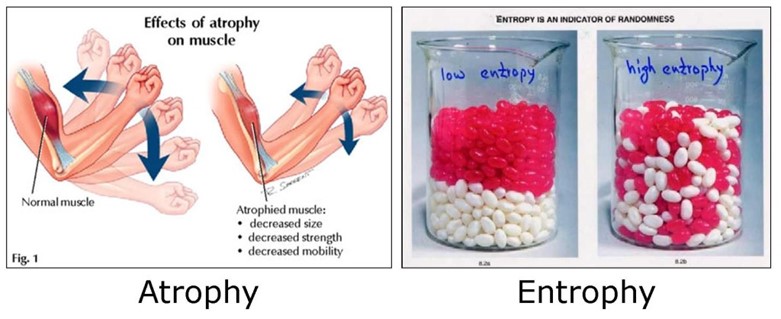
Word Tripper: Atrophy vs. Entrophy

Thursday, March Post a comment

Things break down. Muscles atrophy from lack of use, cars won’t start from lack of maintenance, and houses get messy due to lack of cleaning. Sometimes life just doesn’t go the way you plan, and the entropy of everyday living can take its toll on a person’s body and mind.

http://articles.naiwe.com/files/2021/05/Barbara-McNichol-Word-Tripper-Atrophy-vs.-Entrophy.mp4

Here’s help in making sure your lexicon doesn’t break down. This week’s word tripper highlights the differences between atrophy and entropy.

Atrophy, entropy – Atrophy, a noun and a verb, refers to a gradual loss or wasting away physically or psychologically. It can also refer to poor development. Entropy, a noun, is the degree of disorder or uncertainty in a system. In a technical sense, it’s the gradual breakdown of energy and matter. In casual usage, entropy refers to the disintegration or disorganization of any situation.

“The teenager’s muscles started to atrophy from lying in bed too long. His room, scattered with clothes, shoes, and books, showed a degree of entropy from being neglected.”


Barbara McNichol is a nonfiction editor, who works with authors, speakers, and business professionals to add power to their pen through the written word. Barbara wrote Word Trippers: The Ultimate Source for Choosing the Perfect Word When It Really Matters. She offers helpful writing tips weekly and a course to take your writing and editing to the next level: “WordShops: Strengthen Everything You Write.”

Categories: Barbara McNichol, Editorial Services, Writing

Overcoming Project Paralysis

Tuesday, March Post a comment

In business and in life, we tend to irrationally build things up in our heads and overcomplicate what’s in front of us. We tend to overthink what it takes to complete our next project. In reality, there’s only one requirement: to simply start. Few understand this principle better than Dan Sullivan at Strategic Coach. Dan’s simple 80% Approach is the simplest, clearest recipe we’ve seen for overcoming the two mental habits that stall far too many important projects and entrepreneurs, sometimes “for an entire lifetime.” These two insidious and all too common habits are perfectionism and procrastination.

I’ve compiled key take-aways below from Dan’s book The 80% Approach.


For most projects, 80% is all it takes to successfully launch.

Although the perfectionist says, “no way, it must be exactly correct before releasing,” this habit is entirely an internal struggle. This notion has no basis in the value of the project as perceived by most clients and the outside world. In most instances, the audience will accept 80% as 100%. So, if all that’s needed is 80%, this “gives us permission to nip perfectionism in the bud.” Otherwise, the result is usually unnecessary delays. Engaging clients early in the development process, before we consider it perfect, allows for checkpoints along the way, preventing misalignment on the project’s direction and the potential for rework down the road.


Don’t wait to complete your first 80%.

This is all about baby steps. Instead of looking at the whole and feeling overwhelmed, ask yourself this: What is the next incremental task I can do today to move this project forward. One word or one sentence on paper is sometimes all it takes. One phone call is better than no phone call. Chances are, you’ll get into a flow state and before you know it, you’ve written an entire page, chapter, or article.


Complete the second 80%.

This represents a further improvement to the original 80% effort and is best handled by other talented people. When you compound two 80% efforts, the result is 96% completion. As Dan says, “In a world filled with many sub-standard, shoddy, and unsatisfactory results, a 96%-quality project would look and actually be extraordinary.”


Do only the 80% that only you can do.

Owners, entrepreneurs, founders, and project leaders should be firmly entrenched in their unique abilities, producing their 80% portion of the project from their unique abilities only, “where their personal efforts will produce the best and fastest results.”


Community vs. Isolation – 80% vs. 100%.

When each member of a team is striving for 80% rather than 100%, they’re inspired to rely on each other. This leads to a cohesive environment that fosters genuine teamwork, reliance on each other, and community building. If everyone is focused on achieving 100% individually, they become isolated and full of doubt.


Ultimately, when we give ourselves permission to strive for 80% using our highest and best talents only, we start faster, we gain confidence, and we learn to trust in others to exercise their unique talents to move the project forward. As Dan coins it, “By riding the 80% wave of accelerating confidence, you make rapid progress, find it easy, and want to move even faster.”

You can pick up a complimentary copy of Dan’s book The 80% Approach.


Stephen (Steve”) Colwell serves as CEO and head of strategy for Clarify Media and Completing, two Southern California–based firms specializing in marketing and project management. With over 10 years of hands-on agency experience as a copywriter, brand strategist, and project manager, he brings a broad and deep range of both marketing and operations expertise to the community. From strategy and design to growth and performance, Steve offers a rare mix of creative and analytical thinking toward helping creative professionals, teams, and small businesses accelerate their progress and achieve more. He has led project teams responsible for over $100+ million in annual revenue across four continents. A certified Agile practitioner, Steve is fanatical about helping others work in teams more effectively and operate at their best using the same proven routines practiced by today’s top-performing companies.

Categories: Business, Freelancing, Stephen Colwell

Active-ate Your Verbs and Improve Your Writing

Tuesday, March Post a comment

Before detecting the passive voice and addressing how to change it to active, consider why you should care.

Active verbs will improve your writing (most of the time) because

  • active verbs declare who or what is (or should be) performing the action; you avoid confusion, guesswork, or dodging responsibility
  • active verbs make your writing flow smoothly; readers will easily get the ideas you want to convey
  • sentences constructed in the active voice usually require fewer words; you want to aim to write concisely!


How to Identify Passive

As a reader, if you can’t identify the doer of the action—the subject—the sentence has likely been constructed in the passive voice. Even when the subject is clear, two clues help you identify passive use: (1) the word “by” and (2) variations of the verb “to be.”

Consider these sentences:
Passive—“The juicy watermelon was eaten by the boy.”
Active—“The boy chomped into the watermelon’s juicy belly.”
Passive—“Employees are seen by their managers as responsive and enthusiastic.”
Active—“Managers see their employees as responsive and enthusiastic.”

In addition, passive verbs can foster weasel-like communication. They may be used to hide who’s responsible for an action, thus evading accountability rather than declaring it. For example, if a contract states “the rules for the homeowners will be enforced” but doesn’t note who will enforce those rules, what’s the result? Ambiguity. Confusion. Inaction.


How to Identify Active

The pattern for an active sentence is typically “subject + verb + direct object.” The direct object is the recipient of the action—that is, what or whom the verb affects.

Example: The employees (subject) implement (verb) the new strategy (object).

Who’s doing the action of implementing the new strategy? The employees. Thus, it’s clear the employees are accountable for the action.


Your Turn

Notice the passive construction in the following sentence and rewrite it, making sure to use an active verb. (Hint: You’ll need to make up a subject.)

Passive: This policy is being implemented in an effort to streamline our process.
Active: ___________________________________


Barbara McNichol is a nonfiction editor, who works with authors, speakers, and business professionals to add power to their pen through the written word. Barbara wrote Word Trippers: The Ultimate Source for Choosing the Perfect Word When It Really Matters. She offers helpful writing tips weekly and a course to take your writing and editing to the next level: “WordShops: Strengthen Everything You Write.”

Categories: Barbara McNichol, Editorial Services, Writing

A Great Year for Writing Your Nonfiction Book

Monday, March Post a comment

Did you develop a plan or even start crafting your book?

If so, congratulations! If not, you have a clean slate in this new year—a fresh opportunity to share your expertise with the world!

Look at this year as a fresh start to attract more opportunities and build more connections through the increased exposure a book gives you.  As you do, go for these eight book-writing resolutions to help fulfill your dream of being an author—and all that it brings you—in this wonderful new year.

1. I will devote a significant amount of time to planning how I’ll write or promote my book.

2. I will look for interesting, unique ways to craft my chapters. I want them to be informative, intelligent, and fun to read.

3. I will put into place new ways to promote my book, perhaps even before it’s been produced (e.g., turn parts of chapters into blog posts, use social media to draw attention to them).

4.I will create an ezine or website to convey my book’s concepts, build a list of interested people, and communicate regularly with those who can benefit from my message.

5. I will stop procrastinating! When I’m tempted to put off working on my book, I’ll remind myself of the reputation-building value a professional book brings to my business. It will help me engage with my prospects, gain exposure to my market, demonstrate my expertise, and land new opportunities.

6. I will not let lack of time or dislike of writing stop me. I have something valuable to say to the world, and I will put it out there in a quality way. Yes, I will set aside time to write, revise, and perfect my chapters and my marketing materials.

7. I will ask for help to perfect my manuscript. Knowing there comes a time when I can’t read my own writing objectively, I will ask for writing/editing assistance to polish it to a fine sheen. I’ll be alert to when that time is right.

8. I will do my best to choose the right word when it matters most—and not let grammar gremlins and wrong choices spoil the party.

Barbara McNichol is a nonfiction editor, who works with authors, speakers, and business professionals to add power to their pen through the written word. Barbara wrote Word Trippers: The Ultimate Source for Choosing the Perfect Word When It Really Matters. She offers helpful writing tips weekly and a course to take your writing and editing to the next level: “WordShops: Strengthen Everything You Write.”

Categories: Barbara McNichol, Writing

Best of Word Trippers

Thursday, March Post a comment

If you don’t subscribe to my ezine Word Tripper of the Week, you’re missing out on a regular opportunity to sharpen your word use skills. You’ll find easy explanations of confusing word pairings such as “accept vs. except” and “affect vs. effect.”

Abstruse, obtuse – Abstruse means hard to understand, complex, or highly abstract. It stems from a Latin word meaning concealed or hidden and typically describes texts or arguments. Obtuse describes someone who is (or seems to be, based on behavior) not sharp in thinking, perception, or feeling; it can also refer to a remark, argument, or object that is dull or blunt.

“The teacher lost his students’ attention while describing abstruse philosophical topics to his class. He was too obtuse to notice their lack of participation.”

***

Afflict, inflict – Both words mean to cause pain, suffering, distress, or discomfort. Afflict with the preposition with usually describes an illness or condition. Inflict with the preposition on concentrates on the force with which the pain, suffering, distress, or discomfort is administered.

“He did not intend to inflict shame on his friend with his calloused remark. It would later afflict him with a deep sense of remorse.”

***

Anticipate, predict – Anticipate means to think of something that could happen in the future; to expect or look ahead to something with pleasure. Predict means to declare or indicate in advance; to foretell based on observation, experience, or scientific reason.

“It’s easy to predict the youngsters will have a tough time sleeping as they anticipate their trip to Disneyland.”

***

Archetype, prototype – Derived from the Latin term typus meaning image, the nouns archetype and prototype both relate to an original pattern or model. Each prefix establishes the distinction. Arch refers to the most accomplished or high ranking of something; proto primarily refers to a standard configuration, or an initial model or version of something. Thus, archetype has come to mean an ideal example while prototype is an unrefined version of something that’s expected to evolve.

“With her perfect GPA, inspiring extracurricular activity, and impressive athletic accomplishments, she’s the archetype of a great student and possibly a prototype for a successful entrepreneur.”


Barbara McNichol is a nonfiction editor, who works with authors, speakers, and business professionals to add power to their pen through the written word. Barbara wrote Word Trippers: The Ultimate Source for Choosing the Perfect Word When It Really Matters. She offers helpful writing tips weekly and a course to take your writing and editing to the next level: “WordShops: Strengthen Everything You Write.”

Categories: Barbara McNichol, Editorial Services, Writing

7 Writing Mistakes Editors Are Constantly Fixing

Wednesday, March Post a comment

What can editors tell writers about improving their writing before they even begin the editing process? Here’s a summary:

Mistake #1. Being so self-absorbed as a writer that you’re unaware of the reader’s experience. The fix? Know your core message and write to that message, leaving out the experience of writing.

Mistake #2. Addressing readers as readers rather than as a single key person whose interest you want to capture with your message. The fix? Keep a single interested person in your target audience top of mind as you write.

Mistake #3. Skimming the surface, not going deep enough. The fix? When describing an experience, explain what you felt, what the other person felt as best you can, and what exact words were spoken. Go deeper with the details.

Mistake #4. Having no rhyme or reason to the order of the paragraphs. The fix? Make a conscious decision about the order based on logic, facilitating your readers’ comprehension.

Mistake #5. Overusing weak verbs and throwing in extraneous phrases and wobbly words. The fix? Rewrite using active verbs; question the use of every adjective and adverb; throw out wobbly words: really, very, much, some, that. “I Really Think That We Should Not Use Some Words Very Much.”

Mistake #6. Using multiword noun phrases when one active verb will do. The fix? Whenever possible, get an active verb to do the “work.”

Mistake #7. Writing sentences that ramble (on and on and on and on). The fix? Limit sentences to 15–21 words max and vary sentence length.

Bonus mistake: Mixing metaphors and flat-out choosing the wrong word. The fix? Use a word choice guide to help you select the perfect word when it really matters.


Barbara McNichol is a nonfiction editor, who works with authors, speakers, and business professionals to add power to their pen through the written word. Barbara wrote Word Trippers: The Ultimate Source for Choosing the Perfect Word When It Really Matters. She offers helpful writing tips weekly and a course to take your writing and editing to the next level: “WordShops: Strengthen Everything You Write.”

Categories: Barbara McNichol, Editorial Services, Writing

The Queen’s Gambit – Ep 1: “Openings”

Tuesday, March Post a comment

My daughter Amber recommended The Queen’s Gambit (Netflix) to me because she knows I loved the period piece “The Marvelous Mrs. Maisel” and I’m a chess nut. Good call on her part. After watching Episode 1: “Openings” I thought I might write a series of reviews of the show discussing its use of story devices and comparing it to Joseph Campbell’s Hero’s Journey.


The Prologue

Episode 1 opens with Beth Harmon (Anya Taylor-Joy) waking up, dressing while someone rustles in the bed, taking some pills, rushing from her hotel room, and bursting into a chess match for which she is late. A gaggle of reporters are taking flash photos of her as she shakes her opponent’s hand (an annoyed middle-aged white man) and apologizes profusely for being late. Then, as the chess clock ticks, we flashback to her childhood.

A lot happens in this opening. It establishes our hero as a chess celebrity, a drug abuser, somewhat promiscuous, and possibly under some sort of chess trial. This man is apparently important and she is very differential to him. It sets up a bunch of questions in our minds (who is this woman, who is this man, why is she taking pills, what is the nature of this chess match?) This is a teaser and leads us into the backstory of our hero. It might also be considered a proper prologue setting us up for the main story.


The Ordinary World

As our story begins, we meet young Beth (Isla Johnston) as a nine-year-old child at the scene of a car crash that kills her mother. She’s taken to an orphanage (it is assumed the father is dead) where she’s given a nice cot and meets the folks who will be taking care of her as well as some other orphans—one in particular is Jolene (Moses Ingram).

This is clearly a period piece as all the cars are 1940s style and the police uniform is from the same era. This shot is designed to set the stage for our hero’s Ordinary World.

Jolene is Beth’s first mentor. The mentor character is typically the one who helps the hero understand their new situation or Special World. Jolene explains that the pills she’s given will make her “feel good” and not to overuse them. Jolene also notices the effects of withdrawal when Beth stops taking the pills and explains that as older children, they’re likely “lifers” at the orphanage. Jolene is not so much a mentor as an “expositioner.”

This is an interesting device since we’re actually being introduced to Beth’s Ordinary World by showing her walking into a new situation after having lost her mother (notice how often heroes are orphans, especially in Disney tales). We see this displacement often in storytelling; it creates a fish-out-of-water effect. Mind you, this is not the Special World of the story but just the baseline world our story is taking place in. By having Beth enter a new situation in the opening of the story, she needs Jolene to explain everything to her—and to the viewers as well. Soon, Beth will cross over into the actual Special World of competitive chess.

You might compare this to Karate Kid (1984) where young Daniel has just moved from New Jersey to California with his mother to start a new life. It’s not the Special World of the story but allows us to get a lot of backstory because he’s the new kid in town. In Daniel’s case the Special World is that of competitive karate.

We also see a bit of foreshadowing in the form of the drugs the orphanage staff feed the children. All the children are given green pills (the same green pills we see in the opening scene of Episode 1).


Next, we’re treated to a flashback as Beth remembers her mother burning books and pictures after her father tries to convince mother Mary to come home with him. We see Beth clutch her mother’s bound dissertation on mathematics. Then, we see tear-streaked Mary looking in the car’s rearview mirror saying “I’m sorry” to this younger Beth.

This is classic backstory exposition. It implies mother Mary is a math genius and that she may have some emotional or mental health issues, possibly setting up the mystery of how the accident occurred. Both of these are foreshadowings of Beth’s drug abuse and genius-level chess abilities.


The Call to Adventure and the Refusal of the Call

Beth is given the task of cleaning the teacher’s erasers and goes to the basement to do so. There, she sees the janitor Mr. Shaibel playing chess alone. Beth has never seen chess and demands to be told what it is; Shaibel refuses and sends her away.

Here, the “call” is the chess board reaching out to Beth and capturing her interest. It’s also a “call” to the mentor. And in a twist to the classic monomyth, it is the mentor who refuses the call to adventure. He sends the hero away. And she must return to make the mentor take up the challenge to train her.

This also calls back to the “reluctant mentor” we see in Karate Kid. Mr. Miyagi is approached by Daniel to teach him karate, and Miyagi refuses. (When the teacher is ready, the student will come.) This is also Beth’s introduction to the Special World. Mr. Shaibel is her new mentor, and he will guide her into the Special World of competitive chess.


The Meeting with the Mentor

That night, we see Beth wrestling with her thoughts, and she takes some of the green pills she’s been palming. While in bed, she imagines the chess board on the ceiling. The next day, she returns to Shaibel’s basement and explains that she understood what she saw (this piece moves like this, that one like that. “You learned all that from watching me?”), and now the mentor is interested. Shaibel gruffly allows her to sit at the board, and he begins playing her—but he always plays the white pieces. Eventually, he gives her his personal copy of Modern Chess Openings and allows her to alternate playing both black and white pieces.

Beth has become indoctrinated into competitive chess, and Shaibel has recognized her genius. He accepts her as an apt pupil and comes to realize she is worthy of his mentorship. As mentors do, he is passing on his wisdom and gives her a personal gift that will allow her to traverse the Special World. Compare this to Obi Wan Kenobi’s gift of the lightsaber to Luke Skywalker and taking Luke on as a student of the Jedi way.


Crossing the First Threshold

Later, Beth is introduced to Shaibel’s friend: Mr. Ganz, the head of the chess team at the local high school. He challenges Beth and loses with Beth predicting “mate in three.” We also see Beth beat both men at simultaneous chess. Beth even leaves the table, calling out her final moves destroying Ganz without looking. Ganz arranges for Beth to play simultaneous chess against the boys on his chess team. She wins all the matches with ease. She relates to Shaibel how poorly the boys played and how surprised she was at how easily defeated they were.

Beth has crossed the first threshold: she’s met her first adversaries and conquered them. Now, she will have more trials and new oppositional forces.

We’re also seeing something terribly important, subtle, and necessary in this story: the education of the audience in chess terminology. For the viewer to understand how gifted Beth is, we must be told enough about the game so that we can appreciate it when Beth does well—or perhaps later when she fails.

We can see this in such movies as Top Gun (1986) where Maverick evades and defeats his opponent by performing a maneuver that causes the enemy to fly past him. This is critical in the climax of the film where Maverick saves his buddy using the same technique. In both cases, it’s imperative that the audience has a basic understanding of the hero’s prowess so that we can appreciate it later. To do this, the storyteller must interweave education of the audience with the hero’s journey.

Note that one of the openings Shaibel teaches Beth is the titular The Queen’s Gambit. I have no doubt we’ll see this mentioned again, and it will likely be critical to the story’s climax (see Chekov’s Gun).


The Missing Inner Quality

In the final scene, Beth is watching a movie with her fellow orphans and sneaks away to steal a screwdriver from Shaibel’s toolbox. Using the screwdriver, she unscrews the lock to the infirmary and takes a giant jar containing the green tranquilizer pills. She gulps down a handful of the pills. As she turns to escape with the jar in her arms, her teachers and friends find her standing on the chair caught red-handed. She succumbs to the overdose of pills muttering “Mom?” as she passes out and falls to the floor, dropping the jar, which shatters and floods the room with the pills.

This scene does double-duty. It exposes Beth’s missing inner qualities—drug addiction and the loss of her mother—and provides a cliffhanger so we’ll tune in next week.

These missing inner qualities of Beth’s are the true essence of this story. Beth will have an outer journey as she becomes a chess master. But she will also have an inner journey as she overcomes her drug addiction and comes to grips with her tragic loss. Hero’s journeys are always two-pronged: the outer tangible goal and the missing inner quality. The hero may or may not achieve the outer goal; it really doesn’t matter. But for the audience to achieve catharsis, the inner missing quality must be resolved.

This is a classic cliffhanger. We will tune in next week to see how Beth survives this; we know she will since we saw her in the future during the prologue. I’ll be here next week to look at more structure and story of The Queen’s Gambit.


Greg Smith is a writing coach, editor, and publisher. He founded the Agile Writer Workshop in 2011 with the mission of finding a method to help beginning writers complete a first draft in 6 months. The Agile Writer Method is based on the writings of experts in mythology, screenwriting, psychology, and project management. His seminars on the Agile Writer Method have informed and delighted thousands of writers, scholars, and university students. Agile Writer authors have written over 50 first draft novels and 10 published novels. Greg is a developmental editor for novelists and memoirists. He also coaches authors through the self-publishing maze. Greg runs the popular Agile Readers Book Club where new writers can get a beta read from a dozen or more readers.

Categories: Greg Smith, Writing

Small Claims Copyright Court is Coming!

Monday, March Post a comment

In years past, writers who found themselves in the unfortunate position of finding their work infringed upon would have only one course of action: to take the infringing party to federal court to pursue damages there. This often would require not only a massive time commitment, but the potential for a great expense in court fees, attorney fees, and damages.

In late December 2020 and as part of the Consolidated Appropriations Act of 2021[1], the CASE Act (Copyright Alternative in Small-Claims Enforcement Act[2]) was signed into law. This new amendment to copyright law is an alternative for writers who have been infringed upon as it commissions a Copyright Claims Board (CCB) made up of three copyright officers specially appointed from the U.S. Copyright Office to hear certain small claim infringement cases. The new claims board is set to be established by no more than a year and a half from when the CASE Act was signed into law (or by June 2022).

The CCB will greatly reduce the costs of taking an infringement case to court (at the minimum, $100 and no more than the costs of filing a claim in federal district court). Writers or other copyright holders who wish to bring a claim before the CCB will be able to do so without the need for legal counsel, and the proceedings will be streamlined.

The CCB’s system will be a completely voluntary process, meaning that those who are defendants in an infringement claim will have the option to opt out of the process completely within 60 days of a filing. That said, one of the great incentives for a defendant to appear before the tribunal is that all damages are limited by design to a total of $30,000. In federal court, statuory damages can run up to $150,000 per instance of infringement, and additional damages could be awarded on top of that amount.

The CASE Act will provide an even playing field as the copyright holders will be required to have their work formally registered with the U.S. Copyright Office[3] prior to filing an infringement case before the CCB. Importantly, this requirement for copyright registration in infringement cases (brought to federal court) was recently underscored in the suit Fourth Estate Public Benefit Corporation v. Wall-Street.com[4].

The CASE Act was also designed to help prevent so-called copyright “trolls” from bringing frivolous claims, excessive counterclaims, and fraudulent defenses in front of the CCB. The tribunal would be empowered to penalize bad actors by setting limits on how many claims can be filed each year, awarding attorneys’ fees in extreme cases, and even dismissing all claims filed by abusers of the system.

The passage of the CASE Act and its CCB is significant to copyright law in the United States, and writers can take comfort in knowing that they will have an additional—and less expensive—recourse at their disposal should they find themselves infringed upon.


Mary Jo (“MJ”) Courchesne is the owner and principal consultant of Gryphon Publishing Consulting. A publishing veteran with more than 20 years of experience in trade, academic, and direct-response publishing, she has spent nearly two decades specializing in licensing, subsidiary rights, and permissions. MJ is a frequent and polished presenter on licensing and copyright. When it comes to intellectual property, she firmly believes that everyone from authors to publishers to corporations should know their rights. To that end, MJ instructed in the George Washington University’s Masters in Publishing program for 13 years, first for 11 years as adjunct professor for a course titled Editorial Content, Rights, and Permissions and subsequently as lecturer in a course on copyright. She currently serves on the Board of Experts for the National Association of Independent Writers and Editors and is a member of the Independent Book Publishers Association and the Society of Children’s Books Writers and Illustrators. MJ has also held memberships with other publishing organizations such as the American Society of Picture Professionals and Washington Publishers.

[1] https://rules.house.gov/sites/democrats.rules.house.gov/files/BILLS-116HR133SA-RCP-116-68.pdf see page 2544 for the start of the CASE Act in the Consolidated Appropriations Act omnibus bill

[2] original text: https://www.congress.gov/bill/116th-congress/house-bill/2426/text

[3] https://copyright.gov/registration/

[4] https://www.scotusblog.com/2019/03/opinion-analysis-a-copyright-owner-cant-sue-for-infringement-before-the-register-has-processed-it

Categories: Copyright, MJ Courchesne, Writing

  • « Previous Page
  • 1
  • …
  • 15
  • 16
  • 17
  • 18
  • 19
  • …
  • 26
  • Next Page »

Recent Posts

  • Beyond Writing: How Expanding Your Services Can Strengthen Your Freelance Business
  • Am I a Writer or Not?
  • Be Prepared for That Crisis Moment When You Need Business Backup
  • Stick with Your System
  • In a Pricing Rut? Try These 3 Strategies

Categories

Meta

  • Log in
  • Entries feed
  • Comments feed
  • WordPress.org

Latest Posts

Beyond Writing: How Expanding Your Services Can Strengthen Your Freelance Business

July 22, 2026

Am I a Writer or Not?

July 16, 2026

Be Prepared for That Crisis Moment When You Need Business Backup

June 30, 2026

Stick with Your System

June 29, 2026

In a Pricing Rut? Try These 3 Strategies

June 25, 2026

Improving Your Vision

June 24, 2026

Contact Us

  • 804-476-4484
  • P.O. Box 412
    Montpelier, VA 23192-0412
Facebook Instagram Linkedin twitter

© NAIWE. All rights reserved. Designed by My House of Design.