Member's Library I am what the librarians have made me . . . B. K. Sandwell
  • About
    • About NAIWE
    • Board of Experts
    • Books Published by NAIWE Experts
    • FAQs
    • Advertising
  • Member’s Area
    • Member’s Library
    • Member Website Development
    • Benefit Links and Passcodes
    • Manage Your Account
    • The Member’s Edge
    • NAIWE Media
    • On-Demand Training (Discount)
  • Training
    • Upcoming Webinars
    • On-Demand Training (Discount)
  • Find a Professional
  • News & Events
    • Blog
    • The Edge
    • The Member’s Edge
    • The Edge Writers Guidelines
    • Conference
    • Podcasts
    • Summer Challenge
    • Words Matter
      • Words Matter Week
      • How to Participate
      • Media
  • Post a Job
  • Contact
  • Member Sites

Nifty New Tool: Headline Analyzer

Thursday, March Post a comment

Whenever I hear about a fun writing tool, I have to try it out. Most recently I learned about a nifty headline analyzer from SpeakerNet News (a highly recommended weekly resource for professional speakers and trainers).

For a recent Word Tripper of the Week, I played with various subject lines. After starting with the too-familiar Random Acts of Kindness, the analyzer scored these various ideas and helped me choose one (noted in bold). Which one of these would you have selected? Do you have an idea for a subject line?

  1. The Kinder Side of Life (score of 65)
  2. No Act of Kindness Is Too Small (score of 60)
  3. The Gift of Kindness (score of 62)
  4. Cool To Be Kind (score of 66)
  5. Speak the Language of Kindness (score of 53)

Feel free to experiment with your own headings.

 

Barbara McNichol is a nonfiction editor, who works with authors, speakers, and business professionals to add power to their pen through the written word. Barbara wrote Word Trippers: The Ultimate Source for Choosing the Perfect Word When It Really Matters. She offers helpful writing tips weekly and a course to take your writing and editing to the next level: “WordShops: Strengthen Everything You Write.”

Categories: Barbara McNichol, Editorial Services, Headlines, Writing

5 Characteristics of an Effective, Catchy Blog Post Title

Wednesday, January Post a comment

A blog post’s title has an important job: to get someone to read the post.

It holds that huge responsibility on the shoulders of about 60 to 70 characters—not a lot. That means you have to get creative to make sure every word, letter, space, and punctuation mark in your headline is totally necessary and carries its fair weight.

What makes a good blog headline depends largely on the context where a reader sees it—as they scroll through social media, search on Google, browse your email newsletter, or peruse your website, for example.

But some characteristics of good titles apply across platforms.

Regardless of the platform where you promote a blog post, the title should:

  1. Be eye-catching: Your first hurdle is to catch a potential reader’s attention on the platform where you promote a blog post. Your article title competes with everything else the reader will encounter on the platform, so it has to stand out—what we call a “thumb stopper.”
  2. Make a promise: What will a reader get out of reading your post? The title should tell them not just what you know a post is about but exactly how it’ll serve them.
  3. Leave a curiosity gap: Now you have to get a click. If your headline gives away—or appears to give away—the main points of your post, readers have no reason to click through and learn more. Make the promise clear enough to pique interest, but leave enough questions in the reader’s head to get them to read more.
  4. Be honest: Whatever promises you make and questions you raise in the headline, you must follow through in the blog post. Don’t be salacious just to get a click; it’ll cost you trust with the reader.
  5. Encompass the post: Consider your blog post a hierarchy with the title at the top—it should be a comprehensive explanation of the post. If the title only teases a single detail from the post, you’ll likely exclude some readers and disappoint others.


Dana Sitar has been writing and editing for digital media since 2011, most recently as a copy editor for fintech and personal finance. She trains journalists, writers, and editors on writing for the web through sessions at the annual ACES editors’ conference, Utah Valley University, online courses, and private trainings. Dana has written about work and writing in digital media for publications including the New York Times, HuffPost, a column for Inc. Magazine, and dozens of writing and content marketing blogs. As a branded content editor for The Penny Hoarder, Dana managed a team of writers, editors, and social media experts to create multimedia branded content to help advertisers reach an audience of 12 million across platforms including social media, email, blog, and video.

Categories: Blogging, Dana Sitar, Headlines, Marketing, Writing

What You Need To Know To Write Effective Headlines for 4 Major Platforms

Wednesday, January Post a comment

Unless you write for an authoritative news site or have a rabid audience, you likely rely on external platforms to attract readers to your blog posts.

Whether readers click through to your site and how they perceive your post when they get to it, both depend on the context of that platform where they first discovered it.

  • What mindset were they in on the platform?
  • Why did they approach the platform in the first place?
  • What else did they encounter on the platform before finding your post?

Consider the common platforms and their context and headlines readers will encounter first on those external platforms as you write blog posts.

  1. Social media: Probably the first we think of when we consider platforms for blog post promotion. Social media includes sites like Facebook, Twitter, Instagram (Stories), and Pinterest. Readers here are easily distracted and encounter a wide variety of content. They aren’t thinking about your site or the topic of your blog post before seeing your headline.
  2. Search: Search engine optimization (SEO) is a popular way to craft blog posts that show up in Google search results and attract new readers. Readers here enter a query into the search engine and choose your blog post from among up to 10 related results. They approach the search with a specific question or topic in mind. If your headline promises a good answer and the blog post follows through, they’ll likely be highly engaged with your content.
  3. Email: Readers who subscribe to your blog or email newsletter want to see your latest content, so they’re highly engaged and loyal. Your subject line gets them to open the email, and your headlines within the email should entice them to click through to read the articles in full.
  4. Your home page: Readers who visit your website looking for something to read are extremely loyal. But you still have to catch their attention and get them to click on the content! Understand your core audience and what they most want from you, and use your home page content and blog post headlines to demonstrate that you can deliver.


Dana Sitar has been writing and editing for digital media since 2011, most recently as a copy editor for fintech and personal finance. She trains journalists, writers, and editors on writing for the web through sessions at the annual ACES editors’ conference, Utah Valley University, online courses, and private trainings. Dana has written about work and writing in digital media for publications including the New York Times, HuffPost, a column for Inc. Magazine, and dozens of writing and content marketing blogs. As a branded content editor for The Penny Hoarder, Dana managed a team of writers, editors, and social media experts to create multimedia branded content to help advertisers reach an audience of 12 million across platforms including social media, email, blog, and video.

Categories: Dana Sitar, Headlines, Marketing, Social Media, Writing

Crafting a Knockout Headline

Friday, September Post a comment

Journalists used to be the only ones who had to write headlines. Now business owners are their own bloggers, reporters, and social media managers. Copywriters are crafting webpage headlines, subheadlines, and even email subject lines. It seems like everyone who is either a writer or in the business marketing field needs to know how to write a good headline of some sort . . . even if it’s not a traditional news headline.

I cultivated some experience in headline writing when I was a copy editor for Gannett. I thought I would only be editing stories, but it turned out half my job was creating headlines–and doing it so they’d fit in tight spaces. You learn a lot of really short words when you’re short on space. (Who knew back then that I’d be doing the same thing on Twitter 10 years later, strategizing on which words to cram in headline advertising articles I’d written for other news publications?)

Looking to pen an attention-getting headline that lures readers in and sums up what an article has to say? Here are a few tips.

Determine what word must go in. In news, it’s imperative to have certain words from your story in the headline. If I am writing an article for a health publication about a new cancer drug, I definitely want to get “cancer” in there, if not “new” and “drug” too. In more evergreen content, I may be able to add more phrases, but I still want to know which words must go in. What individual words do you think have to go in the headline so your reader gets the gist of the article? Do you need action words to make the reader take action? Keep this in mind as you identify those “must-add” words.

Know your audience and the medium. Space doesn’t matter as much if you’re on LinkedIn, but it can if you’re working in a print publication or say, for an email newsletter article. Again, if you’re writing for a newspaper, you want to get a few certain key words in the headline so the reader has an idea of what the story is about. Also, you may want a more lax, attention-grabbing headline if the headline is not for a news outlet and is instead a social media post promoting a headline. In news, it’s more of sticking to a few words that sum up the article instead of getting a reader to click on it, though you likely want them to read on for more information. News readers want to be able to skim a headline and get the gist of the development. On the flip side, in copywriting, a headline can give a summary but also be used to engage the reader to take action or read the entire article. Look at past articles or content to get a feel for the tone.

When I’m writing about that cancer drug in news, my headline may be “New Cancer Drug Extends Life,” while an email or social media headline may be “The Cancer Drug That Could Help You Live Longer.” Big difference!

Add action. Depending on where your headline will appear, it’s important to add action. News readers want to know what the news is, while an email subject line (it kind of counts as a headline) will want to drive the user to open the message and convey what they’ll get if they do.

Think phrasing. I love what this article has to say about the phrases we can choose, as certain ones can be more effective for different mediums. Keep in mind that “will make you” and “this is why” may work awesome in an email subject line–but not so great for a news headline. If you’ve got more room, flexibility or the ability to add in a subhead, that’s where a good phrase can come in handy. Otherwise, I stick to identifying the must-feature words and building a headline around those words.


Kristen Fischer is a copywriter and journalist living at the Jersey Shore. She worked as a reporter and copyeditor for Gannett before launching her full-time freelance business in 2005. Her work has been published in Parents, New Jersey Monthly, Prevention, Woman’s Day, SheKnows, and Healthline.

Categories: Headlines, Kristen Fischer

7 Headline Tweaks That Attract Readers to Your Personal Blog

Tuesday, January Post a comment

It’s the dream of many writers—you create a personal blog on a passion topic. Then, you use that blog as a writing sample that helps get you hired for freelance-writing jobs.

Many writers have a blog on their writer website—maybe you’ve got one here on your NAIWE website? The hope is that the blog posts will help you attract clients. Right?

The only problem is, most personal blogs fail to draw the paying clients. And the top reason they fail is the blog-post headlines.

Most post headlines are . . . let’s say . . . not exactly fascinating, which is why most personal blogs have zero comments and zero retweets, too. There are other issues with headlines that keep readers from finding your content, too.

For your personal blog to get you freelance clients, that blog needs to have what marketers call engagement—posts need to get comments and social shares.

If you want blogging clients—or even harbor dreams of monetizing that personal blog—you’ve got to understand how to write amazing headlines that make people simply have to click and read your post.

Luckily, there are simple steps you can take to improve your headlines and turn them into attention-getters that attract clients.


  1. Study Three Little Letters

If you haven’t learned about search engine optimization (SEO) and using keywords to get traffic yet, it’s time. Because post headlines that lack a keyword phrase that helps Google identify and send you interested readers are a complete waste of your time.

Seriously. Don’t even bother writing. Nobody clicks, nobody reads.

What do I mean? Headlines like:

  • “Beware the Red Flags”
  • “It’s About Time”
  • “Biodiversity: It Takes All Kinds”

There are no keyword phrases in the above headlines.

Single-word topic keywords like “biodiversity” don’t get the job done because they’re too difficult to rank. “Threats to Biodiversity” gets 8,000 searches a month, my search tool tells me, and competition for that phrase is relatively low. That’s the sort of keyword phrase you’ll want to use in your headlines.

Get a viable keyword phrase into your post headline, and Google could send you a torrent of new readers.


  1. Use Mystery Sparingly

As you saw above, many blog-post headlines keep readers completely in the dark about what the post covers. That’s not a good thing. Few people are going to click to investigate what this might be about.

However, a little mystery—where we know most of what’s going on, but there’s one unknown or hidden aspect—can be great. For instance, a popular post on my blog is “How I Became a More Productive Writer by Doing This One, Simple Thing.”

This is a known-unknown structure. There’s a topic the reader can identify as something they know about (writing), followed by a mystery item—one thing we don’t yet know. That formula equals: I gotta click.


  1. Promise a Benefit

Most blog post headlines fail because they don’t show what the reader would get out of reading the post. There needs to be some benefit to the reader.

Remember the old WIIFM acronym. Readers are asking, ‘What’s in it for me?” as they scan Google and contemplate reading your post.

Your post headline needs to provide an answer.

A headline like “Threats to Biodiversity” fails this step, because it doesn’t communicate what I might learn that I could use in my life—how I could actually help the situation. I mean, I already know there are threats to biodiversity. Right?

By contrast, a headline like: “3 Threats to Biodiversity You Can Prevent Today.”

Now, that sounds like it has information I could take action on. And I want to read it.


  1. Identify with the Reader

If you can include the reader in your post headline, it helps to attract the right readers. For instance, going back to “How I Became a More Productive Writer by Doing This One, Simple Thing,” you can immediately see it is a post for writers.

It’s not for housewives who want to do chores more efficiently or business executives who want to manage workers more productively; it’s for writers. When people see themselves in the blog-post headline, they tend to get interested.


  1. Don’t Go All In

Many post headlines don’t get clicks because the reader learns what they need to know in the headline. There’s no need to read further. That’s a big problem.

I call these “all in” headlines because everything I need to know is all in the headline.

You don’t want this: “The Border Wall is Just Wrong.”

The reader goes, “OK, I get it. You don’t think we should build the border wall. Done. I agree (or don’t). Got ya.”

Instead, if your headline is: “7 Little-Known Reasons the Border Wall Is Just Wrong”

Now, I might be curious to read what your reasons are. Feels like I might learn something that might affect how I should vote.


  1. Not a Long Story

These days, blog post headlines need to be pretty concise. That’s because you don’t want them to get cut off midway in Google search results. Cutoff headlines tend to get fewer clicks. You want your whole headline to show up.

And yes, you should use a tool to check whether your headline (a/k/a ‘title tag’) is too long, if your blog software doesn’t show you character counts. I like the tool from Moz.

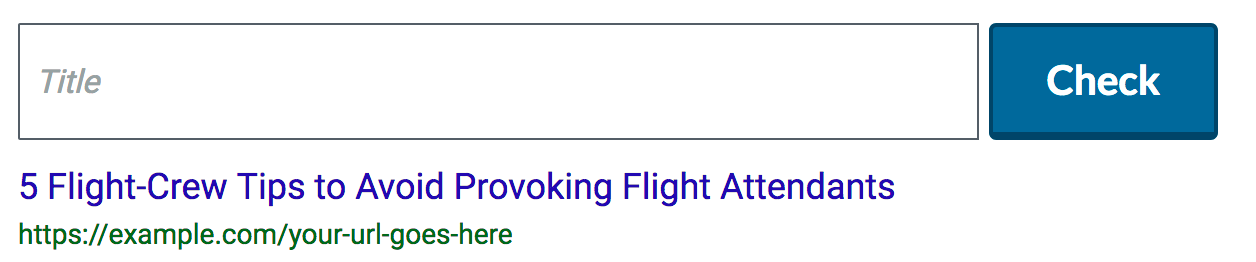
In other words, “5 Flight-Crew Tips to Avoid Provoking Flight Attendants,” which as you can see in the checker tool, displays in full on Google.

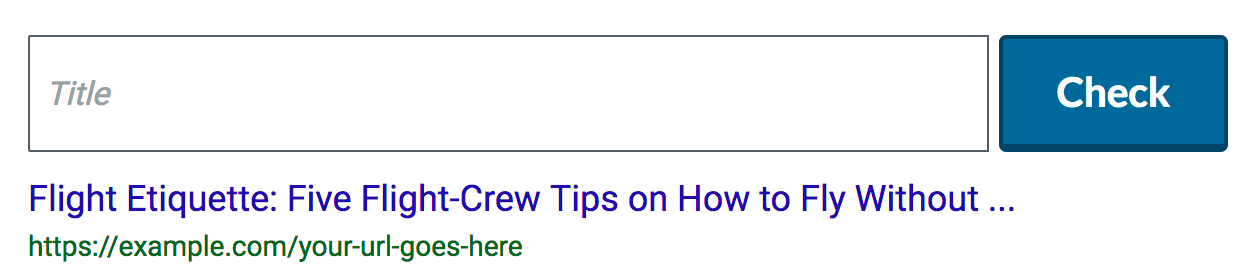
Not this: “Flight Etiquette: Five Flight-Crew Tips on How to Fly Without Provoking Your Flight Attendant.” As you can see below, that gets truncated in a Google search result:

The drift is lost without the end of the headline, likely resulting in far fewer clicks.

Of course, I checked to make sure the headline of this blog post wasn’t too long, as well:

Creating more concise blog-post headlines is a great habit to get into, even if it doesn’t matter for search because blog posts should be narrowly focused. If you can’t write a concise headline about the topic, you probably don’t have your thoughts organized well enough yet to write the piece.


  1. Make Blog Posts Easy to Write

Do you struggle with writing your posts? If so, here’s a tip: Write the headline first.

Too many bloggers write rambling screeds, planning to figure out the headline at the end. That means they’re free to wander off-topic.

Save yourself a lot of rewriting, and work on your headline first. Remember that your first headline idea is probably not your best one—and keep improving until you love the result.


Use Your Personal Blog to Get Clients

By writing stronger headlines, you’ll attract more new readers. Those focused headlines with keyword phrases in them will draw people interested in your topic—and hopefully, some will comment and share your post on social media.

Next thing you know, prospective clients may be checking out your blog and seeing it’s a busy place. Then, they’ll want to hire you to make that happen on their business blog.


Carol Tice is a freelance writer who focuses on writing and ghostwriting business books and e-books. She’s written for Delta Sky, Forbes, Entrepreneur, Seattle Magazine, Costco, American Express, Shopify, Freshbooks, and many others. Carol founded the award-winning Make a Living Writing blog in 2008, which has been repeatedly named to Writer’s Digest’s Top 101 Blogs for Writers list. It now offers over 1,000 free posts on how to break in and grow your writing income. Her Freelance Writers Den learning and support community was founded in 2011 and has over 1,000 members. Carol has taught over 20 online courses and self-published 10+ e-book titles for freelance writers. She’s also the author/coauthor of two traditionally published business books for entrepreneurs.


Categories: Carol Tice, Headlines

Recent Posts

  • Beyond Writing: How Expanding Your Services Can Strengthen Your Freelance Business
  • Am I a Writer or Not?
  • Be Prepared for That Crisis Moment When You Need Business Backup
  • Stick with Your System
  • In a Pricing Rut? Try These 3 Strategies

Categories

Meta

  • Log in
  • Entries feed
  • Comments feed
  • WordPress.org

Latest Posts

Beyond Writing: How Expanding Your Services Can Strengthen Your Freelance Business

July 22, 2026

Am I a Writer or Not?

July 16, 2026

Be Prepared for That Crisis Moment When You Need Business Backup

June 30, 2026

Stick with Your System

June 29, 2026

In a Pricing Rut? Try These 3 Strategies

June 25, 2026

Improving Your Vision

June 24, 2026

Contact Us

  • 804-476-4484
  • P.O. Box 412
    Montpelier, VA 23192-0412
Facebook Instagram Linkedin twitter

© NAIWE. All rights reserved. Designed by My House of Design.