
Member's Library I am what the librarians have made me . . . B. K. Sandwell
  • About
    • About NAIWE
    • Board of Experts
    • Books Published by NAIWE Experts
    • FAQs
    • Advertising
  • Member’s Area
    • Member’s Library
    • Member Website Development
    • Benefit Links and Passcodes
    • Manage Your Account
    • The Member’s Edge
    • NAIWE Media
    • On-Demand Training (Discount)
  • Training
    • Upcoming Webinars
    • On-Demand Training (Discount)
  • Find a Professional
  • News & Events
    • Blog
    • The Edge
    • The Member’s Edge
    • The Edge Writers Guidelines
    • Conference
    • Podcasts
    • Summer Challenge
    • Words Matter
      • Words Matter Week
      • How to Participate
      • Media
  • Post a Job
  • Contact
  • Member Sites

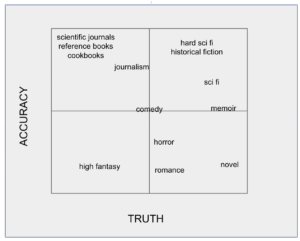
Truth vs. Accuracy in Fiction

Monday, June Post a comment

As a writing coach at the Agile Writer Workshop, I meet a lot of people who want to write a memoir or an autobiography. They usually have a story to tell, and it’s usually pretty personal. I always encourage them to write a memoir rather than an autobiography.  Autobiographies are usually reserved for famous or infamous people. These new writers often have a harrowing story, or they’ve lived through a difficult time, and their friends tell them “you should write a book.”

At the top of their list is to tell everything, exactly as it happened. What they don’t realize is that memoirs are never about accuracy, but about truth.

Memoirs have to be entertaining and they have to focus on just one element of the subject’s life. For example, one great memoir that came out of Agile Writers was about a woman who lived with alopecia (a debilitating loss of hair). As much as she wanted to tell every experience she had, just as it happened, some events had to be deleted or changed, and some individuals were combined into a single character. And some conversations had to be interpolated.

This is done to streamline the story and make it flow better. A memoir, it turns out, is not an accurate retelling of events. Instead, it is a telling of the truth of the events.


Accuracy

There are times when one must tell the events exactly as they happened. In the case of relating the news, the writer must focus on accuracy. If you’re a journalist, for example, the accurate relating of events is a requirement of the job. A journalist who is exposed for telling a half-truth or worse, making up facts, is likely to lose their job.

You also need accuracy in reference books. If you’re writing a scientific paper and make up facts or get your data wrong, you ruin your credibility. Cookbooks, travel guides, dictionaries, and encyclopedias all require accuracy.

In these cases, accuracy trumps everything.


Truth

But how does truth differ from accuracy? It turns out that novels, movies, and memoirs have a lot in common. We can look to them for examples of how truth and accuracy differ.

When telling a news story, what is important is getting the facts straight. But often the why of the story is less important. The backstory of the individuals, their hopes, dreams, and desires are secondary to getting to the facts.

But novels and memoirs are about people and relationships. The reader of a romance novel, for example, will not likely fact-check a scientific or historical fact. Or if they do, it’s not likely to affect their enjoyment of the story.

However, if the lead character of a novel is presented as beneficent and then kicks a dog—the writer has broken with the truth of the story. Either the hero of the story is good—or they’re not. (Of course, it might be part of the story that our hero isn’t as good as we think, but that’s not the point here.) This is truth. It breaks the truth of the story for our hero to be evil.

There are other truths. How does the world the novelist creates compare to the experience of the reader? If, as the writer, you present a world where everyone is happy and gets what they need and life is ideal—your story may not ring true.

So, in the novel or memoir, accuracy doesn’t matter nearly as much as truth.


When You Need Both

But the world is not evenly and cleanly divided between truth and accuracy.


Historical Fiction

If you’re writing a historical novel, you have an obligation to get your historical facts right. In this case, both accuracy and truth are important. Readers of historical fiction look for accuracy in the events of the story and will call out bad facts.

And still the truth of the story must come out. The characters and their relationships must convey the truth of the story and relate to the reader’s own worldview. And the inner consistency of the story must be intact or the truth of the universe you’ve created will shatter.

A good case study in truth and accuracy is Gone with the Wind. In its heyday, it was loved not only for the truth of the story, but its historical accuracy. The depiction of the antebellum South was presented as an accurate portrayal of life on the plantation. Today, we know that Gone with the Wind presented a view of Southern life that was biased and so the accuracy has suffered over time.

Still, the truth of the story remains. The story of a woman who was left to run a plantation and survived against all odds. Likewise, the final scene where her love interest tells her to go to hell is a strong truth.


Science Fiction

Likewise, hard science fiction must adhere to the known facts of current science. If you have a story about life on the moon and you ignore the fact that the moon has one-sixth the gravity of Earth, you will be excoriated by your readers and your critics. And still, the truth of the story must come to the fore, or the reader will put the book down before the last page.

Despite its psychedelic nature, 2001, A Space Odyssey is strongly rooted in scientific accuracy. The depiction of life in space still stands up more than 50 years later. And when we watch this film, we feel the strength of the truth of the story. The fight of a man against a machine is a truth that rings true for people in the 1960s, and even today.


Conclusions

If you’re writing a work of fiction, be it memoir or novel, you’re in the business of telling the truth, not necessarily being accurate. It’s acceptable, even expected that you will sacrifice accuracy to expose the truth of the story. Don’t be confined to the actual streets in a city, the exact timeline of your personal events, or the contents of every conversation you’ve had. Reach for the truth and your readers will be set free.

 

Greg Smith is a writing coach, editor, and publisher. He founded the Agile Writer Workshop in 2011 with the mission of finding a method to help beginning writers complete a first draft in 6 months. The Agile Writer Method is based on the writings of experts in mythology, screenwriting, psychology, and project management. His seminars on the Agile Writer Method have informed and delighted thousands of writers, scholars, and university students. Agile Writer authors have written over 50 first draft novels and 10 published novels. Greg is a developmental editor for novelists and memoirists. He also coaches authors through the self-publishing maze. Greg runs the popular Agile Readers Book Club where new writers can get a beta read from a dozen or more readers.

Categories: Greg Smith, Nonfiction, Writing

The Queen’s Gambit – Ep 1: “Openings”

Tuesday, March Post a comment

My daughter Amber recommended The Queen’s Gambit (Netflix) to me because she knows I loved the period piece “The Marvelous Mrs. Maisel” and I’m a chess nut. Good call on her part. After watching Episode 1: “Openings” I thought I might write a series of reviews of the show discussing its use of story devices and comparing it to Joseph Campbell’s Hero’s Journey.


The Prologue

Episode 1 opens with Beth Harmon (Anya Taylor-Joy) waking up, dressing while someone rustles in the bed, taking some pills, rushing from her hotel room, and bursting into a chess match for which she is late. A gaggle of reporters are taking flash photos of her as she shakes her opponent’s hand (an annoyed middle-aged white man) and apologizes profusely for being late. Then, as the chess clock ticks, we flashback to her childhood.

A lot happens in this opening. It establishes our hero as a chess celebrity, a drug abuser, somewhat promiscuous, and possibly under some sort of chess trial. This man is apparently important and she is very differential to him. It sets up a bunch of questions in our minds (who is this woman, who is this man, why is she taking pills, what is the nature of this chess match?) This is a teaser and leads us into the backstory of our hero. It might also be considered a proper prologue setting us up for the main story.


The Ordinary World

As our story begins, we meet young Beth (Isla Johnston) as a nine-year-old child at the scene of a car crash that kills her mother. She’s taken to an orphanage (it is assumed the father is dead) where she’s given a nice cot and meets the folks who will be taking care of her as well as some other orphans—one in particular is Jolene (Moses Ingram).

This is clearly a period piece as all the cars are 1940s style and the police uniform is from the same era. This shot is designed to set the stage for our hero’s Ordinary World.

Jolene is Beth’s first mentor. The mentor character is typically the one who helps the hero understand their new situation or Special World. Jolene explains that the pills she’s given will make her “feel good” and not to overuse them. Jolene also notices the effects of withdrawal when Beth stops taking the pills and explains that as older children, they’re likely “lifers” at the orphanage. Jolene is not so much a mentor as an “expositioner.”

This is an interesting device since we’re actually being introduced to Beth’s Ordinary World by showing her walking into a new situation after having lost her mother (notice how often heroes are orphans, especially in Disney tales). We see this displacement often in storytelling; it creates a fish-out-of-water effect. Mind you, this is not the Special World of the story but just the baseline world our story is taking place in. By having Beth enter a new situation in the opening of the story, she needs Jolene to explain everything to her—and to the viewers as well. Soon, Beth will cross over into the actual Special World of competitive chess.

You might compare this to Karate Kid (1984) where young Daniel has just moved from New Jersey to California with his mother to start a new life. It’s not the Special World of the story but allows us to get a lot of backstory because he’s the new kid in town. In Daniel’s case the Special World is that of competitive karate.

We also see a bit of foreshadowing in the form of the drugs the orphanage staff feed the children. All the children are given green pills (the same green pills we see in the opening scene of Episode 1).


Next, we’re treated to a flashback as Beth remembers her mother burning books and pictures after her father tries to convince mother Mary to come home with him. We see Beth clutch her mother’s bound dissertation on mathematics. Then, we see tear-streaked Mary looking in the car’s rearview mirror saying “I’m sorry” to this younger Beth.

This is classic backstory exposition. It implies mother Mary is a math genius and that she may have some emotional or mental health issues, possibly setting up the mystery of how the accident occurred. Both of these are foreshadowings of Beth’s drug abuse and genius-level chess abilities.


The Call to Adventure and the Refusal of the Call

Beth is given the task of cleaning the teacher’s erasers and goes to the basement to do so. There, she sees the janitor Mr. Shaibel playing chess alone. Beth has never seen chess and demands to be told what it is; Shaibel refuses and sends her away.

Here, the “call” is the chess board reaching out to Beth and capturing her interest. It’s also a “call” to the mentor. And in a twist to the classic monomyth, it is the mentor who refuses the call to adventure. He sends the hero away. And she must return to make the mentor take up the challenge to train her.

This also calls back to the “reluctant mentor” we see in Karate Kid. Mr. Miyagi is approached by Daniel to teach him karate, and Miyagi refuses. (When the teacher is ready, the student will come.) This is also Beth’s introduction to the Special World. Mr. Shaibel is her new mentor, and he will guide her into the Special World of competitive chess.


The Meeting with the Mentor

That night, we see Beth wrestling with her thoughts, and she takes some of the green pills she’s been palming. While in bed, she imagines the chess board on the ceiling. The next day, she returns to Shaibel’s basement and explains that she understood what she saw (this piece moves like this, that one like that. “You learned all that from watching me?”), and now the mentor is interested. Shaibel gruffly allows her to sit at the board, and he begins playing her—but he always plays the white pieces. Eventually, he gives her his personal copy of Modern Chess Openings and allows her to alternate playing both black and white pieces.

Beth has become indoctrinated into competitive chess, and Shaibel has recognized her genius. He accepts her as an apt pupil and comes to realize she is worthy of his mentorship. As mentors do, he is passing on his wisdom and gives her a personal gift that will allow her to traverse the Special World. Compare this to Obi Wan Kenobi’s gift of the lightsaber to Luke Skywalker and taking Luke on as a student of the Jedi way.


Crossing the First Threshold

Later, Beth is introduced to Shaibel’s friend: Mr. Ganz, the head of the chess team at the local high school. He challenges Beth and loses with Beth predicting “mate in three.” We also see Beth beat both men at simultaneous chess. Beth even leaves the table, calling out her final moves destroying Ganz without looking. Ganz arranges for Beth to play simultaneous chess against the boys on his chess team. She wins all the matches with ease. She relates to Shaibel how poorly the boys played and how surprised she was at how easily defeated they were.

Beth has crossed the first threshold: she’s met her first adversaries and conquered them. Now, she will have more trials and new oppositional forces.

We’re also seeing something terribly important, subtle, and necessary in this story: the education of the audience in chess terminology. For the viewer to understand how gifted Beth is, we must be told enough about the game so that we can appreciate it when Beth does well—or perhaps later when she fails.

We can see this in such movies as Top Gun (1986) where Maverick evades and defeats his opponent by performing a maneuver that causes the enemy to fly past him. This is critical in the climax of the film where Maverick saves his buddy using the same technique. In both cases, it’s imperative that the audience has a basic understanding of the hero’s prowess so that we can appreciate it later. To do this, the storyteller must interweave education of the audience with the hero’s journey.

Note that one of the openings Shaibel teaches Beth is the titular The Queen’s Gambit. I have no doubt we’ll see this mentioned again, and it will likely be critical to the story’s climax (see Chekov’s Gun).


The Missing Inner Quality

In the final scene, Beth is watching a movie with her fellow orphans and sneaks away to steal a screwdriver from Shaibel’s toolbox. Using the screwdriver, she unscrews the lock to the infirmary and takes a giant jar containing the green tranquilizer pills. She gulps down a handful of the pills. As she turns to escape with the jar in her arms, her teachers and friends find her standing on the chair caught red-handed. She succumbs to the overdose of pills muttering “Mom?” as she passes out and falls to the floor, dropping the jar, which shatters and floods the room with the pills.

This scene does double-duty. It exposes Beth’s missing inner qualities—drug addiction and the loss of her mother—and provides a cliffhanger so we’ll tune in next week.

These missing inner qualities of Beth’s are the true essence of this story. Beth will have an outer journey as she becomes a chess master. But she will also have an inner journey as she overcomes her drug addiction and comes to grips with her tragic loss. Hero’s journeys are always two-pronged: the outer tangible goal and the missing inner quality. The hero may or may not achieve the outer goal; it really doesn’t matter. But for the audience to achieve catharsis, the inner missing quality must be resolved.

This is a classic cliffhanger. We will tune in next week to see how Beth survives this; we know she will since we saw her in the future during the prologue. I’ll be here next week to look at more structure and story of The Queen’s Gambit.


Greg Smith is a writing coach, editor, and publisher. He founded the Agile Writer Workshop in 2011 with the mission of finding a method to help beginning writers complete a first draft in 6 months. The Agile Writer Method is based on the writings of experts in mythology, screenwriting, psychology, and project management. His seminars on the Agile Writer Method have informed and delighted thousands of writers, scholars, and university students. Agile Writer authors have written over 50 first draft novels and 10 published novels. Greg is a developmental editor for novelists and memoirists. He also coaches authors through the self-publishing maze. Greg runs the popular Agile Readers Book Club where new writers can get a beta read from a dozen or more readers.

Categories: Greg Smith, Writing

How to Choose a Good Domain Name

Monday, January Post a comment

Everyone knows it’s necessary to have a strong internet presence if you’re going to be a modern writer. Perhaps one of the most difficult decisions you’ll make is the domain name for your site. Or maybe not.

Domain names are becoming less and less important. Today, people are searching for site links with Google using the name of the company, writer, or book title, and not bothering to remember site names. However, you still want your domain name to be professional so you don’t look like a scammer.


Guidelines

That being said, here are some guidelines to good domain name choices.

  1. Short(< 15 characters)
  2. Descriptive of the company, or individual
  3. Easy to say (and spell)
  4. Fairly unique across the web (org and HerosWay.org are very close and two very different sites)
  5. Avoid punctuation(like dashes greg-smith.com)
  6. Avoid numbers(thai-diner-2.com [Do people spell out TWO or the digit 2 or the words TO or TOO.])

NOTE: Single-word domain names have already been scarfed up by the domain harvesting companies. So “Wonderful.today” is never going to be available without paying a hefty fee on the order of thousands of dollars.

NOTE: DO NOT PAY FOR BROKER SERVICES. Brokers claim to be able to get you a deal on harvested domain names, but they almost never broker a deal for less than several thousand dollars.


Top-Level Domains

Your domain name doesn’t have to end in ‘.com’ or any of the usual suspects. Consider a different top-level domain (TLD) for your website.

  • .pro
  • .site
  • .group
  • .world
  • .page
  • .today
  • .guru
  • .info
  • .fyi
  • .name (All of the usual last names are taken, so be creative, or use both first and last names.)

I’m stunned and amazed that .writer is not a TLD.


Suggestions & Resources

I’d recommend a domain with two words, both short. Like WritersBounty.com or such. For international, consider “WritersBounty.world”—the domain harvesters haven’t stolen dual-word domains yet!

Here’s an extensive list of TLDS and prices you can expect.

And here’s GoDaddy’s search engine for domain names. Make sure yours isn’t already taken!


Finally…

Regardless of what you choose, be sure to do a sanity check with friends, relatives, and coworkers. Google your own domain name components to see what else shows up and see if you’ve picked something that yields unexpected results (go ahead and Google “writers bounty” from my example, above; you may be surprised). Above all, have a little fun!


Greg Smith is a writing coach, editor, and publisher. He founded the Agile Writer Workshop in 2011 with the mission of finding a method to help beginning writers complete a first draft in 6 months. The Agile Writer Method is based on the writings of experts in mythology, screenwriting, psychology, and project management. His seminars on the Agile Writer Method have informed and delighted thousands of writers, scholars, and university students. Agile Writer authors have written over 50 first draft novels and 10 published novels. Greg is a developmental editor for novelists and memoirists. He also coaches authors through the self-publishing maze. Greg runs the popular Agile Readers Book Club where new writers can get a beta read from a dozen or more readers.


Categories: Greg Smith, Marketing

How to Write an Apology in 4 Easy Steps

Friday, November Post a comment

It’s going to happen—you’re going to do or say something stupid. And you’re going to apologize.

If you’re in the public eye in any way, it’s critical that when you make a mistake, you also make a heartfelt apology. There are four parts to a proper apology. Here is your guide to writing an apology that is sincere and has a good chance of repairing the damage done.

A couple years ago I sent an invitation to my membership with a sentence that offended more than one person. In the invitation I wrote what I thought was a funny joke:

There will be soft drinks, heavy whores-de-ovaries, and door prizes!

One of my writers wrote to tell me she and others found the joke offensive. I had to retract what I had said in short order.


Part One: Describe it and own it

In this first part of your apology, describe what happened. You don’t have to give all the gory details. But you have to be clear that what happened was real, you wish it hadn’t happened, and you recognize it was wrong.

You may have seen this done badly by politicians, actors, and other public figures.

Avoid phrases like:

  • I am sorry my comments were taken out of context.
  • I am sorry if anyone took offense by what I did.
  • It is unfortunate that so many were offended by what I said.

These sorts of comments are a non-apology. They put the responsibility for the offense on the recipients. You must own whatever it was that you did wrong. Here’s what I wrote in my apology email:

In my last email I used a barnyard joke that I had learned in my youth and gave little thought to. A good friend alerted me to my indiscretion, and to my horror, I realized I’d said something stupid and offensive.


Part Two: State your standards

It’s critical that you let your audience know that what you said or did does not meet your standards for excellence. Remind them what you expect of yourself and others in your organization. Make it clear that your actions did not come up to those high standards.

Agile Writers has always been about inclusiveness and respect. And in this moment I’ve failed you all in that goal. Sadly, as this was sent in a mass email, there is no way to take my mistake back.


Part Three: Apologize

State clearly that you apologize for your actions. Don’t hedge. Don’t blame circumstances (like illness, stress, the weather, etc.).

I hope that you will accept my deepest apologies and disregard my mistake and will still feel welcome to come to our party.


Part Four: Learn from your mistake

Let your audience know that you’re human. You make mistakes. And you will accept this error as a learning opportunity to improve yourself. You want the reader to know you don’t want this to happen again.

My lesson learned is that I still have biases that I have to re-evaluate and overcome. I will endeavor to do better in the future.


Conclusion

You’re human and you have a wide audience. Inevitably you’re going to make a public mistake that you will have to apologize for. Own it, remind everyone of your standards, apologize unequivocally, and learn from your mistake. If you do this, people will remember your apology far longer than your error.


Greg Smith is a writing coach, editor, and publisher. He founded the Agile Writer Workshop in 2011 with the mission of finding a method to help beginning writers complete a first draft in 6 months. The Agile Writer Method is based on the writings of experts in mythology, screenwriting, psychology, and project management. His seminars on the Agile Writer Method have informed and delighted thousands of writers, scholars, and university students. Agile Writer authors have written over 50 first draft novels and 10 published novels. Greg is a developmental editor for novelists and memoirists. He also coaches authors through the self-publishing maze. Greg runs the popular Agile Readers Book Club where new writers can get a beta read from a dozen or more readers.

Categories: Business, Freelancing, Greg Smith

Public Library Shuns Writer

Saturday, May Post a comment

From Publishers’ Weekly:

“YA author Julia Watts has been removed from the slate of authors participating in LitUp, a teen literary festival sponsored by the Knox County (Tenn.) Public Library that was inspired by a teen book festival of the same name launched last year in the Kansas City area. Knoxville’s inaugural LitUp festival is scheduled to take place on October 13 with a full day of programming, including appearances by 10 YA authors, a mix of regional and national names.

“According to Watts, a local indie bookseller who is involved in the LitUp festival’s planning asked her in July to be one of its featured authors. ‘My name and photo went up on the website,’ she said. Last Friday, however, that same bookseller called Watts to tell her that she was no longer slated to appear, as, after Googling her name, a member of the organizing committee had expressed concerns that she has also written erotica.”

I’ve seen this before. When a public organization or non-profit decides they don’t like what an author has written, they withdraw support. In this case, Julia Watts is in every way a “legitimate” writer. While she’s written erotica (which is essentially pornography in print), she was not presenting that content. She was presenting her traditionally published YA/LGBTQ fiction.

This is a case of confusing the author and the art. There is no law against writing pornography. Generally speaking, there is a difference between erotic romance and erotica.

While I don’t allow erotica in my workshops (I tell the writers no worse than R-rated content, please), I have never turned an author away for their content. I wonder if this library would have turned Shel Silversteen away for writing for Playboy? I certainly think not.

Shunning authors for any reason is unacceptable. Content does not maketh the man*. If an author has a catalog that includes works that are essentially illegal, that is one thing. But shunning an author for artistic expression is the worst form of censorship.

Read More at Pubisher’s Weekly.

* I hope you will forgive my appropriation of the cliché and its associated gender bias.

Some Definitions

Erotic romance, according to a definition from the Romance Writers of America, refers to “novels in which strong, often explicit, sexual interaction is an inherent part of the love story, character growth, and relationship development and could not be removed without damaging the storyline.”

And erotica? “Erotica is just people doing it,” says Cordelia Logan, who has written 19 stories under five pen names and is beginning to focus on BDSM. (To maintain privacy, she declined to reveal her pseudonyms.) “[Characters] are having sex in interesting ways and with interesting people,” she says. “There’s not a lot of character development. The plot revolves around how these people are going to do it, and what’s getting in the way.”


Greg Smith is a writing coach, editor, and publisher. He founded the Agile Writer Workshop in 2011 with the mission of finding a method to help beginning writers complete a first draft in 6 months. The Agile Writer Method is based on the writings of experts in mythology, screenwriting, psychology, and project management. His seminars on the Agile Writer Method have informed and delighted thousands of writers, scholars, and university students. Agile Writer authors have written over 50 first draft novels and 10 published novels. Greg is a developmental editor for novelists and memoirists. He also coaches authors through the self-publishing maze. Greg runs the popular Agile Readers Book Club where new writers can get a beta read from a dozen or more readers.

Categories: Greg Smith, Writing

Good vs. Bad Book? Don’t Judge

Friday, October Post a comment

K.M. Weiland is an excellent resource for writers of all types. Her website Helping Writers Become Authors should be on everyone’s shortlist of helpful websites. Also, her books on writing are excellent and merge well with Agile Writer theory. But in a recent site article titled “Why Do So Many Bad Books Sell on Amazon?” she steps over the line from advice to judgment.

In the article, Marsh explains that Amazon has started promoting e-books that are newer—like only 30 days old. This has allowed “ghostwriters” to churn out new stories using a template from a previous book (replace princess with enchantress, replace castle with mansion, etc.). Thus, these writers are producing a book a month and getting (presumably) good sales.

Ms. Marsh argues that this promotes bad books. At Agile Writers, the definition of success is getting your book into the hands of readers who want them. If readers are buying these copycats, then they are probably satisfied. Otherwise, they’d return them (you can return e-books, you know). Therefore, these are not bad books. They are finding a home with people who crave the same plotlines with different characters and locations. The romance genre is rife with this sort of churning.

And that’s, okay.

It’s the responsibility of the author to work the system—to play the game—to get their work into the hands of readers who want to read it. Knowing how the game is played and then playing the game well does that.

Ms. Marsh goes on to lay out a plan to deliver good books (in her estimation) by splitting a novel into segments that are released every 30 days. This is a brilliant strategy the uses the Amazon system to the author’s benefit. There is no need to qualify good vs. bad.

The READER determines what is good or bad, not the author—and not the algorithms at Amazon nor the publishers in the ivory towers of the Big Four publishing houses.

I heartily recommend Ms. Marsh’s article because it lays out the information you’ll need to get your book in front of more readers’ eyes.

However, this should be only one arrow in your quiver of promotional tools. Remember – Amazon is a destination site. People go there because THEY KNOW WHAT THEY ARE LOOKING FOR. Impulse buys on Amazon are far less likely than in a brick-and-mortar store like Barnes & Noble or Books-A-Million. People go to bookstores, newsstands, drug stores, and others without knowing precisely what book they want – if any.

But because the self-published author doesn’t have the advantage of in-store sales, we have to rely on self-promotion. And by self-promotion I mean social media and search advertising.

Learn the rules of the game. Then play the game well. The definition of a good book is one that finds its reader. Make sure your book finds its home in the hands of the reader waiting for it.


Greg Smith is a writing coach, editor, and publisher. He founded the Agile Writer Workshop in 2011 with the mission of finding a method to help beginning writers complete a first draft in six months. The Agile Writer Method is based on the writings of experts in mythology, screenwriting, psychology, and project management. His seminars on the Agile Writer Method have informed and delighted thousands of writers, scholars, and university students. Agile Writer authors have written over 50 first draft novels and 10 published novels. Greg is a developmental editor for novelists and memoirists. He also coaches authors through the self-publishing maze. Greg runs the popular Agile Readers Book Club where new writers can get a beta read from a dozen or more readers.

Categories: Book Marketing, Greg Smith, Writing

Recent Posts

  • Beyond Writing: How Expanding Your Services Can Strengthen Your Freelance Business
  • Am I a Writer or Not?
  • Be Prepared for That Crisis Moment When You Need Business Backup
  • Stick with Your System
  • In a Pricing Rut? Try These 3 Strategies

Categories

Meta

  • Log in
  • Entries feed
  • Comments feed
  • WordPress.org

Latest Posts

Beyond Writing: How Expanding Your Services Can Strengthen Your Freelance Business

July 22, 2026

Am I a Writer or Not?

July 16, 2026

Be Prepared for That Crisis Moment When You Need Business Backup

June 30, 2026

Stick with Your System

June 29, 2026

In a Pricing Rut? Try These 3 Strategies

June 25, 2026

Improving Your Vision

June 24, 2026

Contact Us

  • 804-476-4484
  • P.O. Box 412
    Montpelier, VA 23192-0412
Facebook Instagram Linkedin twitter

© NAIWE. All rights reserved. Designed by My House of Design.