
Member's Library I am what the librarians have made me . . . B. K. Sandwell
  • About
    • About NAIWE
    • Board of Experts
    • Books Published by NAIWE Experts
    • FAQs
    • Advertising
  • Member’s Area
    • Member’s Library
    • Member Website Development
    • Benefit Links and Passcodes
    • Manage Your Account
    • The Member’s Edge
    • NAIWE Media
    • On-Demand Training (Discount)
  • Training
    • Upcoming Webinars
    • On-Demand Training (Discount)
  • Find a Professional
  • News & Events
    • Blog
    • The Edge
    • The Member’s Edge
    • The Edge Writers Guidelines
    • Conference
    • Podcasts
    • Summer Challenge
    • Words Matter
      • Words Matter Week
      • How to Participate
      • Media
  • Post a Job
  • Contact
  • Member Sites

How to Use a Planner to Put Authors and Editors on the Same Page

Sunday, May Post a comment

Through a blog post, I recently asked what worries nonfiction authors about the editing process. The insights gained can be helpful to any editor as well as the authors they work with.

I received the following array of answers from 40 authors who responded. Specifically, they want:

  • more than a clean up; they want a major step up in clarity
  • support in thinking through the book’s organization before nitty-gritty editing begins
  • their book editor to be tuned in to their objectives for the book, keeping them top-of-mind throughout the process
  • their points made more succinctly and artistically and their stories told well.

As one author said, “An unedited piece can make my point but in a less elegant way than one that’s been edited.”

From the first contact with a client, I open a dialog through what I call a Planner—a questionnaire that focuses on the long-term goals for the book itself. Questions not only address the mechanics of editing but emphasize the author’s big-picture dreams. A few are:

  1. What successful books would be good models for yours?
  2. After people in your target audience have read this book, what do you want them to say about it? How would you like a testimonial to read?
  3. What actions do you want readers to take as a result of reading your book—both for their own benefit and for yours?
  4. What changes do you want to create in your life/business as a result of putting this book out into the world?
  5. Which results do you seek most in working with an editor (followed by a list for ranking)?

 

Barbara McNichol is a nonfiction editor, who works with authors, speakers, and business professionals to add power to their pen through the written word. Barbara wrote Word Trippers: The Ultimate Source for Choosing the Perfect Word When It Really Matters. She offers helpful writing tips weekly and a course to take your writing and editing to the next level: “WordShops: Strengthen Everything You Write.”
Categories: Barbara McNichol, Editorial Services, Writing

Word Choice: When to Use “Like” vs. “Such As”

Sunday, May Post a comment

When it comes to word choices and deciding what to use in your writing, check out these phrases from a book I’m editing:

. . . the answers that so-called geniuses like/such as Newton seem to embody.

. . . centuries of innovations like/such as the airplane and the space shuttle have resulted.

Here’s why “such as” is preferred instead of “like” in these phrases: The word “like” implies comparison while “such as” implies inclusion. Thus, being like something doesn’t include the thing itself. If the sentence was “they’re like a fish trying to swim upstream,” then it’s a clear comparison.

Let’s examine this more closely. In the first phrase, the author does include Newton as a so-called genius, so “such as” is the better choice. Similarly, in the second phrase, the airplane and space shuttle are examples of innovations, so they’re meant to be included.

Do you see how your intended meaning within the context of your writing helps you choose which word to use?

Your challenge: When you’re about to write “like,” ask this question: Would I include this point in a list or exclude it? That’s your clue on selecting “like” (exclude) or “such as” (include).


Barbara McNichol is a nonfiction editor, who works with authors, speakers, and business professionals to add power to their pen through the written word. Barbara wrote Word Trippers: The Ultimate Source for Choosing the Perfect Word When It Really Matters. She offers helpful writing tips weekly and a course to take your writing and editing to the next level: “WordShops: Strengthen Everything You Write.”
Categories: Barbara McNichol, Editorial Services, Writing

Word Tripper: Breach vs. Breech

Sunday, May Post a comment

Every practice has its tricks of the trade. In this week’s Word Tripper, the trick to knowing the difference between the homonym “breach” and “breech” is this: “Breach,” meaning to open by force or break an agreement, is spelled with an “ea” like the word “break” itself.

If writing is part of your trade, use this trick to differentiate between these two words both in meaning and spelling. Happy Word Tripping!

Breach, breech – As a noun, “breach” is a failure to do what’s required or promised; a break in friendly relations between people or groups; a hole or opening in something created by force. As a verb, it means to fail to do what’s required or promised; to force an opening or break an agreement. “Breech,” a noun, refers to the hind end of something. For example, a breech birth occurs when an infant’s bottom comes out first during delivery. “Breech” is also the part of a firearm (e.g., a rifle or cannon) found at the rear end of its barrel.

“It’s clearly a breech birth when the doctor sees the newborn’s bottom breach the birth canal.” – Dr. Ron Minson


Barbara McNichol is a nonfiction editor, who works with authors, speakers, and business professionals to add power to their pen through the written word. Barbara wrote Word Trippers: The Ultimate Source for Choosing the Perfect Word When It Really Matters. She offers helpful writing tips weekly and a course to take your writing and editing to the next level: “WordShops: Strengthen Everything You Write.”
Categories: Barbara McNichol, Editorial Services, Writing

Should It Be One Word or Two?

Thursday, May Post a comment

As I was finalizing a manuscript I edited for a nonfiction author, I hired a proofreader to give it a final check. (I knew I’d read it too many times myself.) What she found humbled me. I thought I had a good handle on which words are customarily two words versus one (backyard—not back yard—comes to mind) but several surprised me.

My proofreader corrected these (verified on dictionary.com). Look familiar?

  • rooflines (not roof lines)
  • safe-deposit box (not safe deposit box)
  • old-timers (not old timers)
  • carsick (not car sick)
  • safekeeping (not safe keeping)
  • autopilot (not auto pilot)
  • pocketknife (not pocket-knife)


Barbara McNichol is a nonfiction editor, who works with authors, speakers, and business professionals to add power to their pen through the written word. Barbara wrote Word Trippers: The Ultimate Source for Choosing the Perfect Word When It Really Matters. She offers helpful writing tips weekly and a course to take your writing and editing to the next level: “WordShops: Strengthen Everything You Write.”

Categories: Barbara McNichol, Editorial Services, Writing

Word Tripper: Benevolent vs. Beneficent

Sunday, April Post a comment

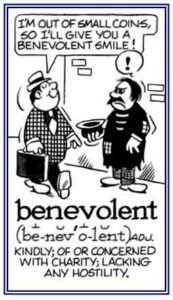
The Random Acts of Kindness Foundation is a non-profit organization that inspires a culture of kindness in schools, homes, and communities. It encourages acts of kindness by providing resources to people who are both benevolent and beneficent.

This week’s Word Tripper clarifies the difference between these similar words.


Image Source: http://wordinfo.info/unit/293/page:2


Barbara McNichol is a nonfiction editor, who works with authors, speakers, and business professionals to add power to their pen through the written word. Barbara wrote Word Trippers: The Ultimate Source for Choosing the Perfect Word When It Really Matters. She offers helpful writing tips weekly and a course to take your writing and editing to the next level: “WordShops: Strengthen Everything You Write.”

Categories: Barbara McNichol, Editorial Services, Writing

Grammar Glitches You Can’t Ignore

Monday, March Post a comment

My attention was recently drawn to an article in Ragan Report (great resource for communicators) that puts the “Top 25 Grammar and Language Mistakes” in your face.

This handful of grammar glitches stood out for me. I’m eager to point them out because they’re extremely important to good writing. I encourage you to take them to heart.

  • Using could of, would of, should of. These are all 100 percent wrong, born of our sloppy speaking styles—could’ve, would’ve, should’ve. What you want to write is could have, would have, should have. We all coulda, woulda, shoulda become better at grammar.
  • Using me and somebody. I tell my children that it’s common courtesy to put the other person first. Thus, you should always say, Fred and I went to the gym together, or Suzie and I saw that movie.
  • Using that instead of who (and vice versa). If you’re writing about people, always use who. If a company president says, employees that are affected by layoffs will be greatly missed, no one is likely to believe him because he’s treating them as objects by using the word that.
  • Using they when referring to a business. Starbucks said they would give everyone a free latte today. Although this might sound right, the correct sentence is: Starbucks said it would give everyone a free latte today. And if that grates on your ears, then rewrite the sentence to avoid the problem: Starbucks is offering everyone a free latte today.


Barbara McNichol is a nonfiction editor, who works with authors, speakers, and business professionals to add power to their pen through the written word. Barbara wrote Word Trippers: The Ultimate Source for Choosing the Perfect Word When It Really Matters. She offers helpful writing tips weekly and a course to take your writing and editing to the next level: “WordShops: Strengthen Everything You Write.”

Categories: Barbara McNichol, Editorial Services, Writing

Word Tripper: Envelop vs. Envelope

Thursday, March Post a comment

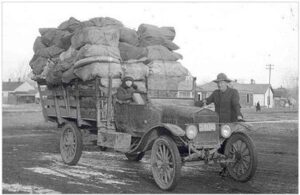
The U.S. Postal Service processes 6,050 mail pieces every second, employs more than 8 million people, and is part of a $1.3 trillion mailing industry that envelops most of the known world.

Overloaded mail truck used by a mail contract carrier in Cody, Wyoming

This pair, envelop and envelope, differ by just one letter and are different parts of speech with distinct meanings.

Envelop, envelope – Envelop, a transitive verb, means to completely cover, enclose, or surround someone or something. Envelope, a noun, is a flat container that covers a letter or other object, often for mailing or delivery. It also refers to a set of performance or conventionally accepted limits.

“Let me envelop you in the warm, fuzzy envelope of my love.” – Gary Michael

“She pushed the envelope of her endurance by running an extra mile.”

“Enveloped by the stacks of papers he had to grade, he felt overwhelmed.”


Barbara McNichol is a nonfiction editor, who works with authors, speakers, and business professionals to add power to their pen through the written word. Barbara wrote Word Trippers: The Ultimate Source for Choosing the Perfect Word When It Really Matters. She offers helpful writing tips weekly and a course to take your writing and editing to the next level: “WordShops: Strengthen Everything You Write.”

Categories: Barbara McNichol, Editorial Services, Writing

Nifty New Tool: Headline Analyzer

Thursday, March Post a comment

Whenever I hear about a fun writing tool, I have to try it out. Most recently I learned about a nifty headline analyzer from SpeakerNet News (a highly recommended weekly resource for professional speakers and trainers).

For a recent Word Tripper of the Week, I played with various subject lines. After starting with the too-familiar Random Acts of Kindness, the analyzer scored these various ideas and helped me choose one (noted in bold). Which one of these would you have selected? Do you have an idea for a subject line?

  1. The Kinder Side of Life (score of 65)
  2. No Act of Kindness Is Too Small (score of 60)
  3. The Gift of Kindness (score of 62)
  4. Cool To Be Kind (score of 66)
  5. Speak the Language of Kindness (score of 53)

Feel free to experiment with your own headings.


Barbara McNichol is a nonfiction editor, who works with authors, speakers, and business professionals to add power to their pen through the written word. Barbara wrote Word Trippers: The Ultimate Source for Choosing the Perfect Word When It Really Matters. She offers helpful writing tips weekly and a course to take your writing and editing to the next level: “WordShops: Strengthen Everything You Write.”

Categories: Barbara McNichol, Editorial Services, Headlines, Writing

Whack Extraneous Phrases in Your Writing

Thursday, March Post a comment

In their classic book The Elements of Style, Strunk and White called word clutter “the leeches that infest the pond of prose, sucking the blood out of words.”

You can start by eliminating extraneous phrases that clutter your writing. But which phrases can be “whacked”?
Consider taking out these extra phrases whenever you can:

  • “is intended to”; “meant to”; “designed to” e.g., He gives a workshop that is designed to teach writing skills. Better: He gives a workshop that teaches writing skills.
  • “it is all about”; “the fact of the matter is”; “the fact that”; “it’s important to remember that” e.g., The fact of the matter is that it’s unwise to go out carousing. Better: It’s unwise to go out carousing.
  • “in regard to” e.g., Seek additional websites in regard to your industry. Better: Seek additional websites in your industry.
  • “is going to” e.g., He is going to be a key contributor. Better: He will be a key contributor.
  • “in order to” e.g., Add key words in order to describe the new position. Better: Add key words to describe the new position.
  • “there is” and “there will be” e.g., There will be many managers attending the meeting. Better: Many managers will attend the meeting.
  • “the reason why is that” e.g., A simple “because” will suffice.
  • “at this time” e.g., Now!

To reinforce this exercise, take something you wrote and circle any of these extraneous phrases. Challenge yourself to rework or remove them altogether. You may choose to keep some in, but at least you’ve asked the question: “Do I really need this phrase?” (In this sentence, “really” is an extra word.)

Keep this list handy. What would you add to it?


Barbara McNichol is a nonfiction editor, who works with authors, speakers, and business professionals to add power to their pen through the written word. Barbara wrote Word Trippers: The Ultimate Source for Choosing the Perfect Word When It Really Matters. She offers helpful writing tips weekly and a course to take your writing and editing to the next level: “WordShops: Strengthen Everything You Write.”

Categories: Barbara McNichol, Editorial Services, Writing

Word Tripper: Atrophy vs. Entrophy

Thursday, March Post a comment

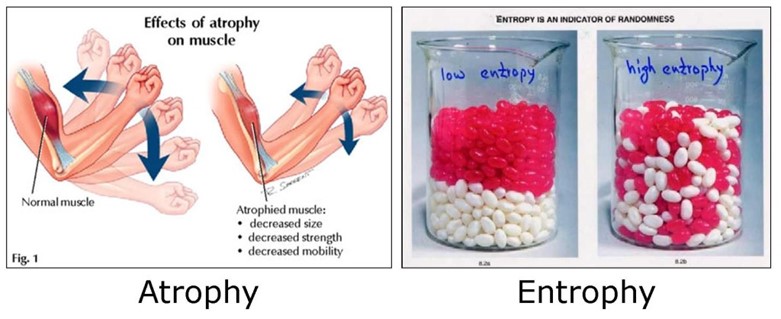
Things break down. Muscles atrophy from lack of use, cars won’t start from lack of maintenance, and houses get messy due to lack of cleaning. Sometimes life just doesn’t go the way you plan, and the entropy of everyday living can take its toll on a person’s body and mind.

http://articles.naiwe.com/files/2021/05/Barbara-McNichol-Word-Tripper-Atrophy-vs.-Entrophy.mp4

Here’s help in making sure your lexicon doesn’t break down. This week’s word tripper highlights the differences between atrophy and entropy.

Atrophy, entropy – Atrophy, a noun and a verb, refers to a gradual loss or wasting away physically or psychologically. It can also refer to poor development. Entropy, a noun, is the degree of disorder or uncertainty in a system. In a technical sense, it’s the gradual breakdown of energy and matter. In casual usage, entropy refers to the disintegration or disorganization of any situation.

“The teenager’s muscles started to atrophy from lying in bed too long. His room, scattered with clothes, shoes, and books, showed a degree of entropy from being neglected.”


Barbara McNichol is a nonfiction editor, who works with authors, speakers, and business professionals to add power to their pen through the written word. Barbara wrote Word Trippers: The Ultimate Source for Choosing the Perfect Word When It Really Matters. She offers helpful writing tips weekly and a course to take your writing and editing to the next level: “WordShops: Strengthen Everything You Write.”

Categories: Barbara McNichol, Editorial Services, Writing

  • « Previous Page
  • 1
  • 2
  • 3
  • 4
  • Next Page »

Recent Posts

  • Beyond Writing: How Expanding Your Services Can Strengthen Your Freelance Business
  • Am I a Writer or Not?
  • Be Prepared for That Crisis Moment When You Need Business Backup
  • Stick with Your System
  • In a Pricing Rut? Try These 3 Strategies

Categories

Meta

  • Log in
  • Entries feed
  • Comments feed
  • WordPress.org

Latest Posts

Beyond Writing: How Expanding Your Services Can Strengthen Your Freelance Business

July 22, 2026

Am I a Writer or Not?

July 16, 2026

Be Prepared for That Crisis Moment When You Need Business Backup

June 30, 2026

Stick with Your System

June 29, 2026

In a Pricing Rut? Try These 3 Strategies

June 25, 2026

Improving Your Vision

June 24, 2026

Contact Us

  • 804-476-4484
  • P.O. Box 412
    Montpelier, VA 23192-0412
Facebook Instagram Linkedin twitter

© NAIWE. All rights reserved. Designed by My House of Design.