
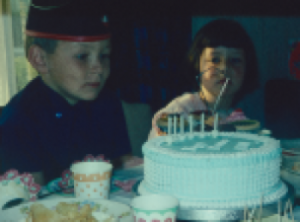
 The author sits down to write their memoir, relying on journals written over a period of years, copious notes, vision boards, and an outline. They open a blank document, ready to begin, pulling from their memory as they write their opening scene. But suddenly they make a daunting realization, one that stops them mid-sentence. July 6 was a Tuesday, right? Or was it a Thursday? And was Grandma Jean the one who knocked the cake over or was it Aunt Susan? Writing comes to a standstill as the author grapples with these questions, unable to proceed due to a fear of sharing anything but the truth.
Does a memoir need to be strictly true and only stick to the facts? Or can it be mostly true? Is it even possible for a memoir to be based only on the truth? As studies into human memory show us, telling the truth and nothing but the truth in a memoir is an unattainable goal. Adding in creative writing elements that depend upon one person’s perspective and interpretations push that goal even further into the sphere of unreality.
When readers pick up your memoir, they are more interested in the theme and the emotional experience tied to your narrative. They already have an expectation that it won’t be completely factual. One reason for this is because creative nonfiction tends to have a novel-like quality when it is read. Real people are represented as characters and may lose some of their real-life nuance, conversations won’t be recalled or shared word for word, and settings and places integral to the story will be filtered through the author’s recollections and perspective. In some cases, details will need to be omitted since they’ve been forgotten or are only vaguely recalled, leading to an incomplete picture.
It may seem obvious that our memories are imperfect. After all, how many of us can remember conversations verbatim we had earlier in the day, let alone years ago? But there are other factors at play that affect the reliability of our memories. One now famous study, led by Samantha Loftus, discovered that human memory is malleable. That is, we can be led to believe something that never happened is a memory from an event in our past. Related studies have shown that not only do we believe these events really occurred, but we tend to be confident in these beliefs. A 2014 study found that even when participants were wrong when it came to identifying someone in a video, many of them stated they were 90 to 100 percent confident in their answer.
These and other memory-related studies help show that complete reliability is an impossibility when it comes to writing a memoir. Memory alone, then, may not be enough to convince the reader that a memoir is based on the truth. How, then, can an author add authenticity to their manuscript? Research can be a helpful tool when it comes to pinning down details or confirming dates. This can often be done from home now that many libraries, newspapers, and historical societies are uploading historical documents for online use.
But what about adding in or confirming personal information? Going through old photos and revisiting key places can sometimes provide these details or back up what one remembers (for instance, the author may remember wearing a blue shirt on a momentous day while photos taken of the event show the shirt was actually yellow). Talking to others who were there or who also remember a person or place can add a new perspective, and in some cases, may fill in gaps the author didn’t even realize were present. For example, if my younger brother were to write a memoir and include a scene at our paternal grandmother’s house, I might remember not only that there was a wool blanket draped across the back of the couch, but also the color scheme, pattern, its general itchiness, and that children were discouraged from eating or drinking near it.
While it might not be possible to share personal viewpoints and lived experiences with the claim that every word and memory is 100 percent factual, this doesn’t need to detract from a memoir’s overall message or theme. Shared truths, stories of redemption and resilience, and tales of a life uniquely lived can still inspire, bring people together, and help someone feel an emotional connection even when accounting for the limitations of human memory.
Qin, Shaozheng, Erno J. Hermans, Hein J. F. van Marle, and Guillén Fernández. “Understanding Low Reliability of Memories for Neutral Information Encoded under Stress: Alterations in Memory-Related Activation in the Hippocampus and Midbrain.” Journal of Neuroscience, March 21, 2012. https://www.jneurosci.org/content/32/12/4032.short.
Wixted, John T., Laura Mickes, and Ronald P. Fisher. “Rethinking the Reliability of Eyewitness Memory.” Sage Journals, May 2, 2018. https://journals.sagepub.com/doi/full/10.1177/1745691617734878.
 Jennia Herold D’Lima is a full-blown logophile. She joined her high school’s newspaper in ninth grade, winning statewide awards for her writing, and expanded her journalism skills by continuing to write and edit throughout her high school years and as a college freshman. While earning her BA in psychology (and minoring in cultural anthropology with a focus on precolonial Mesoamerica) and her MA in applied developmental psychology, her writing and editing naturally skewed toward all things academic. Writing for and publishing in peer-reviewed journals, editing papers for classmates, and writing parenting resource guides honed her research skills. Jennia joined multiple professor-led research groups and completed four internships throughout her academic career. After graduating with a master’s, she worked at a national nonprofit in Washington, DC, and as an assistant researcher at the University of Washington in Seattle. Jennia gradually transitioned to full-time editing. She enjoys traveling, volunteering, and taking creative photos of books and book-related items in those rare moments when she is not reading or editing.
Leave a Reply