Member's Library I am what the librarians have made me . . . B. K. Sandwell
  • About
    • About NAIWE
    • Board of Experts
    • Books Published by NAIWE Experts
    • FAQs
    • Advertising
  • Member’s Area
    • Member’s Library
    • Member Website Development
    • Benefit Links and Passcodes
    • Manage Your Account
    • The Member’s Edge
    • NAIWE Media
    • On-Demand Training (Discount)
  • Training
    • Upcoming Webinars
    • On-Demand Training (Discount)
  • Find a Professional
  • News & Events
    • Blog
    • The Edge
    • The Member’s Edge
    • The Edge Writers Guidelines
    • Conference
    • Podcasts
    • Summer Challenge
    • Words Matter
      • Words Matter Week
      • How to Participate
      • Media
  • Post a Job
  • Contact
  • Member Sites

Ghostwriter or Collaborator?

Saturday, February Post a comment

I keep seeing the same question pop up on message boards and writers’ groups around the web in various forms:

Should I look for a ghostwriter or a collaborator?

Should I work with my clients as a ghostwriter or collaborator?

Is there really any difference between ghostwriting and collaborating?

Oh, my, yes.

Collaborators tend to be accomplished writers and authors. They know how to make nonfiction prose sparkle. They know how to infuse life into characters and drama into a storyline. They know how to make a book saleable.

What they don’t know is how to keep all that out of their clients’ books.

It’s all a matter of investment.

Think about it for a moment. When a writer puts their name on a piece of work, they automatically become invested in that work. It’s unavoidable: no writer willingly attaches their name to something they’re not proud of. To make sure they’re proud of the work, then, a collaborator or co-author must make sure the work meets their personal standards. It has to say what it “should” say the way it “should” be said—especially if the collaborator has worked or written in the given nonfiction field or published their own novel(s).

How then, can a collaborator not become emotionally, psychologically, and, in so many co-author situations, financially invested in the project?

Ah, but it’s the author’s book: the author’s story, the author’s nonfiction research, the author’s concept or political spin or inspirational memoir or biographical exposé. It’s the author’s time to shine, the author’s moment to stand in the spotlight. In many cases, it’s the author’s one and only chance for that fifteen minutes of fame Andy Warhol promised us all.

Authors want their book to be them. All them. They’re entitled, after all, to their own pride of authorship.

And collaborators, experienced or not, want their bylines and the piece of the action they feel they’ve rightfully earned.

Hmmm—do you sense a potential for conflict?

Comparatively, ghostwriting is clean, quarrel-free, and invisible. Regardless of their own personal style, previous knowledge , or perspective on the book, ghostwriters work only with the author’s material. They don’t slant research toward their own agenda. They don’t insist on the book going one way if the author wants it to go another. They remain professionally separate  even while providing the emotional/psychological support aspiring authors need.

Ghostwriters make sure the book says what the author wants it to say, in the author’s voice and style, with the author’s intent and perspective. They are professionals, not partners. They provide editorial services for a negotiated fee on an agreed deadline.

When they don’t put their name on a book, it’s because it isn’t their book.

Ghostwriters invest only their time and expertise in a project no matter how much they like (or dislike) it, not their digestive tracts, their emotional stability, or their financial well being. Ghostwriters accept that their authors are experts in their nonfiction fields just as they are experts in the book business.

They understand that authors want to write the novel that’s been running in the back of their head for years or decades, not a “better” one based on their concept, setting, characters, or circumstances.

But what about all those ghostwriters who do put their names on their clients’ books and do take a percentage of their authors’ advance and royalties?

I cannot speak for them. The thought of taking credit for someone else’s ideas, research, or story is anathema to me. My business is based on fulfilling other people’s literary dreams.

I’m a professional ghostwriter.



Claudia Suzanne is a consummate ghostwriter/teacher, understanding what authors need in order to successfully complete their book dream, and she has a finely honed talent for communicating what she knows to her students and clients. Popularly dubbed “The Einstein of Ghostwriting,” Claudia has entertained and informed tens of thousands of writers, editors, journalists, and aspiring authors at countless writer and professional meetings, conferences, radio and BlogTalk radio broadcasts, webinars, and podcasts. Claudia was an invited expert on Penguin’s Author Solutions Expert Video series and a featured entrepreneur in Orange County Business Journal and Norwegian Business Daily. Her signature title, This Business of Books: A Complete Overview of the Industry from Concept through Sales, earned her a 2018 Author of Influence Award from Connected Women of Influence.


 

Categories: Claudia Suzanne, Ghostwriting, NAIWE Board of Experts

Switch Gender

Saturday, February Post a comment

There you are, a man trying to write female characters or a woman trying to write men. How do you make them believable?

You can fall back on stereotypes. You can lift from your favorite book, TV, or movie characters. Or you can connect to the “other” in your own spirit.

Now, don’t get discouraged; I’m not going “airy-fairy” on you. I’m talking about reaching into the depths of your writer’s psyche and recognizing that you can, if you allow yourself to, get in touch with the opposite gender that resides in us all.

Very few people are all male or all female. Except for those few creatures who live on the extreme ends of the male-female spectrum that ranges from Sweet Young Thing to Manly Man, all women have at least some male sensibilities, just as all men have at least some female sensibilities. It’s only our fear of acknowledging and accepting those attributes that prevent us from having full access to our internal opposites.

Try it! Change your protagonist’s gender. See where it takes you. Don’t default to how you think the opposite gender would view the circumstances. Give yourself permission–as an artist, as a right-brained creator–to be the other gender, to experience the situation as someone with different sexual organs, thought processes, agendas, perspectives, and motivations, someone devoid of your own gender’s stereotypes, prejudices, and preconceptions.

Let me know what happens. Bet it nudges your creativity in ways you never thought possible…


Claudia Suzanne is a consummate ghostwriter/teacher, understanding what authors need in order to successfully complete their book dream, and she has a finely honed talent for communicating what she knows to her students and clients. Popularly dubbed “The Einstein of Ghostwriting,” Claudia has entertained and informed tens of thousands of writers, editors, journalists, and aspiring authors at countless writer and professional meetings, conferences, radio and BlogTalk radio broadcasts, webinars, and podcasts. Claudia was an invited expert on Penguin’s Author Solutions Expert Video series and a featured entrepreneur in Orange County Business Journal and Norwegian Business Daily. Her signature title, This Business of Books: A Complete Overview of the Industry from Concept through Sales, earned her a 2018 Author of Influence Award from Connected Women of Influence.
Categories: Claudia Suzanne, Ghostwriting, NAIWE Board of Experts

Your Fast Track to a Bestseller

Saturday, February Post a comment

bestseller2

(with apologies and thanks to Steve Harrison)

If you’d like your title to be a bestseller — maybe even a New York Times Bestseller — then this post is for you.

An author emailed me after one of my recent panels on ghostwriting. She said, “Claudia, you know so much about the book business. What do I have to do to make my book into a bestseller?”

She had been writing all her life and had a Creative Writing degree from an impressive school. Her teachers loved her book. Her friends and family raved about it. She got 4 and 5-star reviews on Amazon.

But when it came to actual sales — those just trickled in.

I suspected the reason her book wasn’t selling well had nothing to do with her ability to spin a tale, create wonderful characters, or bounce nouns off verbs.

She obviously had good writing skills.

What she didn’t have was a formula for taking her ideas from concept to bestseller status.

So I sent her the seven simple questions below.

(If you’d also like your book to be a bestseller, ask yourself these questions and see if you can answer “YES” to each one.)

Question #1 — Do you have a strong first draft, AND a well-structured second draft, punchy lined-edited third draft, and carefully copy-edited fourth draft?

Question #2 — Do you have the three strongest, most diverse BISAC Subject Headings attached to your nonfiction ISBN? Do you have the best-niche BISAC Subject Heading attached to your fiction ISBN? Do you have the three best Amazon.com categories and 10 top keywords to position your book as a bestseller?

Question #3 — Do you have honest reviews from total strangers who you haveNOT paid but who have actually read your entire book?

Question #4 — Do you have a list of high-volume buyers AND a one-sheet that gets them to say, “Wow, this is great! We need your title”?

Question #5 — Do you have a marketing kit that connects your title to a current, hot, or “sexy” news topic?

Question #6 — Do you have a business plan for online AND offline marketing and promotion? Do you have a list of organizations and groups that need to hear about your book AND a one-sheet that gets them to call you to speak?

Question #7 — Do you have a ready supply of physical books to sign and sell at the back of the room?

My new pen pal responded “NO” to most of the questions. (She had written a strong first draft and she had a supply — a large supply, in fact — of physical books to sell.)

So I wrote back, “That’s wonderful–now you know the missing pieces you need.”

This is the Point Where I’m Supposed to Pitch My Services-

…but I really meant to write more of a post than an advertorial, so let’s leave it here:

If you answered “NO” to any of the questions and would like my help filling in the gaps of your “bestseller plan,” email me at claudiasuzanne@gmail.com or call me at 1-800-641-3936 (USA) or 1-714-954-0580 (International).

If you want to do the heavy lifting yourself and need a coach or a guide, I’m here for you.

If you want referrals to other great people who can help you, here’s my short list:

Flo Selfman’s copy editing
Devon Blaine’s book publicity
Penny Sansevieri’s online marketing
And (of course) Steve Harrison’s publicity and speaking programs

I look forward to seeing your bestseller!


Claudia Suzanne is a consummate ghostwriter/teacher, understanding what authors need in order to successfully complete their book dream, and she has a finely honed talent for communicating what she knows to her students and clients. Popularly dubbed “The Einstein of Ghostwriting,” Claudia has entertained and informed tens of thousands of writers, editors, journalists, and aspiring authors at countless writer and professional meetings, conferences, radio and BlogTalk radio broadcasts, webinars, and podcasts. Claudia was an invited expert on Penguin’s Author Solutions Expert Video series and a featured entrepreneur in Orange County Business Journal and Norwegian Business Daily. Her signature title, This Business of Books: A Complete Overview of the Industry from Concept through Sales, earned her a 2018 Author of Influence Award from Connected Women of Influence.

Categories: Business, Claudia Suzanne, Editorial Services, Ghostwriting, NAIWE Board of Experts

Don’t Forget to Line Edit!

Saturday, February Post a comment

KcnbnRacq

“Too wordy.”

“Paragraphs too long.”

“Sentences too long.”

These are the kinds of things I hear from agents and publishers at writers conferences and behind authors’ backs.

“Can’t figure out what it says.”

“Style/tone is too flat.”

“Booorrrrring.”

No, you don’t need to rewrite or go back to school for more creative-writing or composition techniques.

You need to line edit.

Line editing is the vital but often overlooked pass that adds music, drive, energy, and rhythm to a finished manuscript.

It’s an intermediate edit, between your last rewrite and sending the manuscript to a copy editor. Line editing is all about internal-paragraph Slinky Flow.

  • It challenges every passive-voice line for power, invisibility, and convertibility.
  • It revises static and awkward phrasings.
  • It punches up the drives, smoothes out the pacing, and adds impact to the words already on the page.
  • It brings out the hidden rhythm and music in your writing.

Psst! Don’t Tell Anyone, but-

…you already have the editing skills you need to make this happen —  you just never thought to apply them! So here’s a fast tutorial for doing this essential tweak:

  1. Convert passive voice to active prose unless it’s powerful, invisible, or unavoidable.
  2. Eliminate static phrasings and extraneous articles whenever possible.
  3. Use one set of descriptors per incident. This may mean having to choose which is the most vibrant or effective modifer, but good writing is, after all, about making decisions.
  4. Break up long paragraph blocks for easier reading and visual esthetics.
  5. Brighten or “punch” important points with the judicious use of stand-alone non-sentences. I can’t emphasize this enough. Avoid diluting the impact of your ideas by burying it in excessive verbiage–like I just did!
  6. Let every speaker have their own paragraph.
  7. Reduce extraneous editorial wherever possible by “showing” or demonstrating what you want to say–but not so much that it obscures your point, confuses the reader, or disrupts the pacing.

Try it. It’s fun, it’s easy, and it’ll boost your book’s appeal to both the industry and your reading audience.

Line editing can flip a “Nice Read” into “Wow! What a page turner!”

Happy editing!


Claudia Suzanne is a consummate ghostwriter/teacher, understanding what authors need in order to successfully complete their book dream, and she has a finely honed talent for communicating what she knows to her students and clients. Popularly dubbed “The Einstein of Ghostwriting,” Claudia has entertained and informed tens of thousands of writers, editors, journalists, and aspiring authors at countless writer and professional meetings, conferences, radio and BlogTalk radio broadcasts, webinars, and podcasts. Claudia was an invited expert on Penguin’s Author Solutions Expert Video series and a featured entrepreneur in Orange County Business Journal and Norwegian Business Daily. Her signature title, This Business of Books: A Complete Overview of the Industry from Concept through Sales, earned her a 2018 Author of Influence Award from Connected Women of Influence.

Categories: Claudia Suzanne, Ghostwriting, NAIWE Board of Experts

Why I Can’t Write Quickbooks

Saturday, February Post a comment

I can add and subtract, multiply and divide. I can balance a checkbook. I can keep track of income and expenses on a spreadsheet. I can determine sales tax and apply seller discounts. I can figure out what percentage of my gasoline costs is deductible. I can even fill out my own partnership tax forms if I have enough time.

Lots of time.

I’m talking serious clumps of uninterrupted hours.

And M&Ms.

Basic bookkeeping. Profit and loss. Cash flow. Retained earnings. All the accounting doo-dads and business jargon those QuickBooks magicians need to make business financials run smoothly. Accounting, as someone once explained, is a specialty profession; one that’s essential for all manner of banking, business, investments, and taxes. People go to college to learn its myriad aspects and intricacies. No business can expect to be successful without proper accounting.

Just as no book can expect to be successful without proper writerly skills.

An accountant’s math skills are to my abilities to write, edit, and comprehend intricate prose. Those spreadsheets and percentages? Outlining, character studies, and basic plot architecture. An accountant’s Schedule K is on the same level of concentrated effort as applying APA style guides to a 425-page master’s thesis.

Just like accounting is a specialty profession, so, too, is ghostwriting.

Sure, any aspiring author can open whatever word processor strikes their fancy and clickity-clack type out enough words to rival War and Peace, but it likely won’t have the same finesse as it would if they had access to my kind of expertise. Just like a CEO absolutely can open QuickBooks and navigate the truly brain-folding double-entry system but come tax time there likely will be some missed deductions.

Luckily for those aspiring authors, ghostwriters like me love creative analysis and musical line editing. We relish literary intricacies as much as the math-heads who take delight in their accounting tasks. Not only are ghostwriting’s myriad tasks more fun than trying to figure out QuickBooks, they’re far less mind-bending, that’s for sure.

More power to those accountants. Hats off to them! I’ll just be over here with my manuscript structure and plot/character integration.

And M&Ms. Can’t forget the M&Ms.


Claudia Suzanne is a consummate ghostwriter/teacher, understanding what authors need in order to successfully complete their book dream, and she has a finely honed talent for communicating what she knows to her students and clients. Popularly dubbed “The Einstein of Ghostwriting,” Claudia has entertained and informed tens of thousands of writers, editors, journalists, and aspiring authors at countless writer and professional meetings, conferences, radio and BlogTalk radio broadcasts, webinars, and podcasts. Claudia was an invited expert on Penguin’s Author Solutions Expert Video series and a featured entrepreneur in Orange County Business Journal and Norwegian Business Daily. Her signature title, This Business of Books: A Complete Overview of the Industry from Concept through Sales, earned her a 2018 Author of Influence Award from Connected Women of Influence.

Categories: Claudia Suzanne, Ghostwriting, NAIWE Board of Experts

Why I Ghostwrite

Saturday, February Post a comment

I know, I know–I keep answering questions instead of posting about stuff. But since people want to know why I ghostwrite, here’s my answer:

Why I Ghostwrite

Ghostwriting is a lucrative business for those who know the difference between putting someone else’s name on a manuscript they’ve written and actually ghostwriting another person’s book. I’ve ghosted more than 200 titles and mentored/coached countless writers over the last thirty-plus years to support the people in my life. It’s been a good run.

But I don’t do it for the money.

Ghostwriting is also an educational pursuit. I’ve acquired more knowledge about history, business, healthcare, psychology, addiction, neurodivergence, gender, marketing, religion, science, and just plain human nature from the books I’ve ghosted than I ever learned—our could have learned—in college.

But I don’t do it for the learning.

Ghostwriting is an intimate endeavor. I’ve been privy to the confidences of people along every spectrum: economic, political, gender, sexual-orientation, race, creed, religion, mental health, career, job, disability. Sharing slivers of so many people’s lives has been an extraordinary privilege and a remarkable journey.

But I don’t do it for the human connection.

I do it for the book.

I love books. How they smell when they’re new. How they open my eyes to ideas I never considered before. How they make me laugh, cry, cringe, gasp, or have to walk away. Books, even more than film or music, chronicle the slice of what the author was experiencing right then—a slice already gone, never to return. They preserve those miniscule, already past but cherished, rewarding, and instructional dots in the human experience we call life.

That’s why I ghostwrite. Because ghostwriting is, above all else, about the book.


Claudia Suzanne is a consummate ghostwriter/teacher, understanding what authors need in order to successfully complete their book dream, and she has a finely honed talent for communicating what she knows to her students and clients. Popularly dubbed “The Einstein of Ghostwriting,” Claudia has entertained and informed tens of thousands of writers, editors, journalists, and aspiring authors at countless writer and professional meetings, conferences, radio and BlogTalk radio broadcasts, webinars, and podcasts. Claudia was an invited expert on Penguin’s Author Solutions Expert Video series and a featured entrepreneur in Orange County Business Journal and Norwegian Business Daily. Her signature title, This Business of Books: A Complete Overview of the Industry from Concept through Sales, earned her a 2018 Author of Influence Award from Connected Women of Influence.

Categories: Claudia Suzanne, Ghostwriting, NAIWE Board of Experts

What IS Editorial Accountability?

Saturday, February Post a comment

I mentioned “Editorial Accountability” in a previous post, so I figured I oughta explain what that actually means. These days, digital publishers use algorithms to detect many of these issues and either reject or downgrade work accordingly.


So Just What is Editorial Accountability?

One of the most frequent complaints I’ve fielded from literary agents, acquisition editors, and general-trade reviewers over the thirty-plus years I’ve been in the book industry is that authors don’t know anything about the book business. And being mono-focused on their book, they’re don’t have the time or wherewithal to figure it out.

Let’s rectify that right now.

Editorial Accountability is an umbrella term that essentially refers to the objective quality of a book’s content, writing, editing, and presentation. Realize, that has nothing to do with the subjective take on whether a title is a “good book” or not. Rather, it’s all about whether a manuscript — or even published book — conforms to industry standards of professional work, both creatively and mechanically.

Does editorial accountability matter if you’re looking for a literary agent or traditional publisher? Yes, absatively. It demonstrates that you understand the difference between an author-vision first draft and a reader-satisfying second draft. Going by my experiences with and observations about hundreds of successful and missed-potential titles, I have to say that difference is one of, if not the most, important elements of a top-selling title.

Does editorial accountability matter if you’re going to self-publish? Once again, absatively yes. Amazon’s database contains literally billions — billions! — of titles. Why do some get read and most don’t? Editorial accountability.


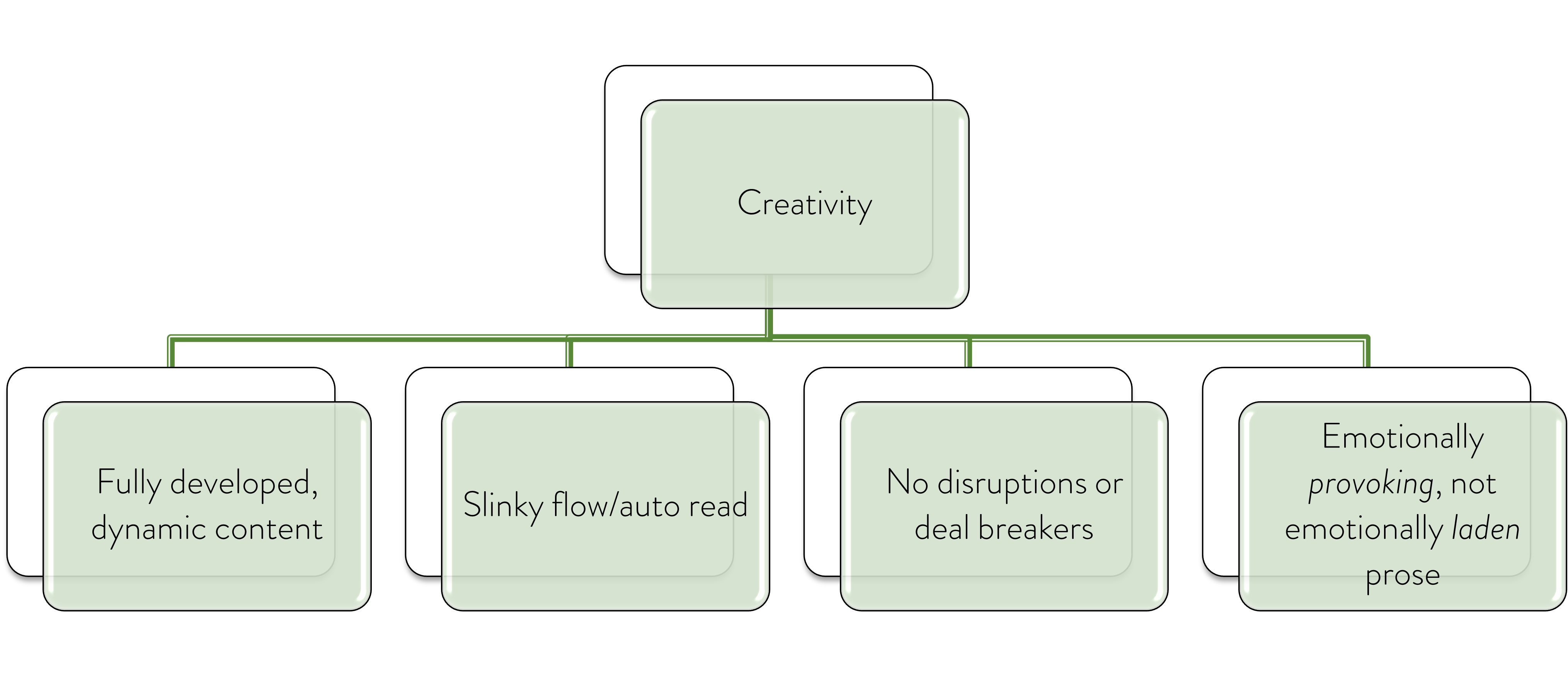
Creative Accountability

a Smart-Art graphic of the four elements of creative accountability: fully developed, dynamic content; Slinky flow auto read, no disruptions or deal breakers, emotionall provoking, not laden, prose

  1. The first part of creative accountability is about full development, whether the book is nonfiction, a memoir, or a novel. The information, personal recollections, or story not only needs to be dynamic, it needs to have purpose. Every chapter, section, scene, paragraph, and sentence must be there for a reason.
  2. Part two is about Slinky® flow, i.e., “the sequence of information or story in which one idea logically and smoothly follows another throughout a paragraph, section, chapter, and manuscript.” Slinky flow encourages auto-read, “the brain’s ability to understand quickly and effortlessly and absorb easily.”
  3. Part three refers to content disruptions (“issues that make a cold reader hesitate or say, “Huh?”) and deal breakers (“issues that make a cold reader stop reading and thus reduce or ruin a manuscript or book’s chances of success”).
  4. The final piece of creative accountability has to do with the work’s prose. Describing how awful or wonderful or surprising or inspiring something/someone/some situation or circumstance is/was/will be comes across as emotionally laden Demonstrating how awful or wonderful or surprising or inspiring something/someone/some situation or circumstance is/was/will be is emotionally provoking prose.

If that sounds an awful lot like the difference between “Show” and “Tell,” that’s only because it’s exactly the same thing. But those terms are so trite at this point, they’ve become meaningless to most aspiring writers.


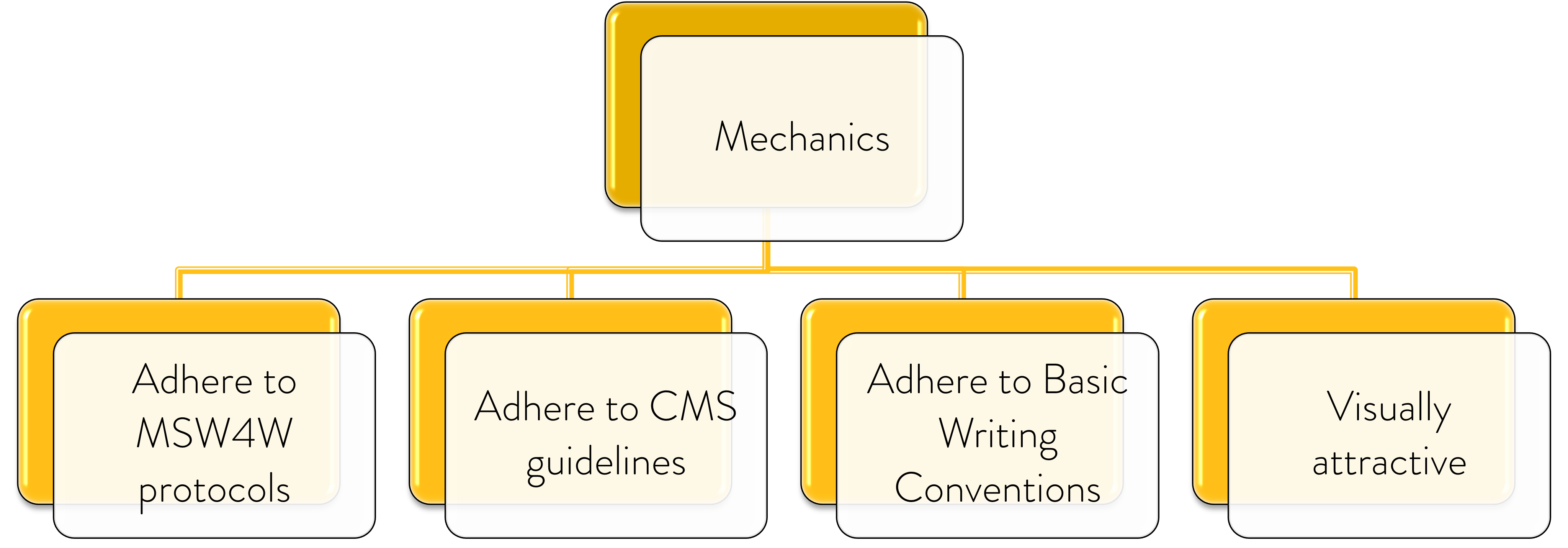
Mechanical Accountability

A Smart-Art graphic of the four elements of mechanical accountability" adhere to MSW$W protocols, adhere to CMS guidelines, adhere to basic writing conventions, visually attractive

Mechanical accountability comes down to making sure the manuscript is:

  1. Clean of extraneous coding and styled correctly in Microsoft Word, which is still the standard of the industry,
  2. Gramatically aligned with Chicago Manual of Style (CMS) guidelines, another standard of the industry,
  3. Copy edited and proofread by at least two different cold eyes, and
  4. Formatted with standard margins, font type and size, and section breaks. Oh, and it doesn’t SHOUT AT THE READER. That gets old real fast.


Acquire Editorial Accountability

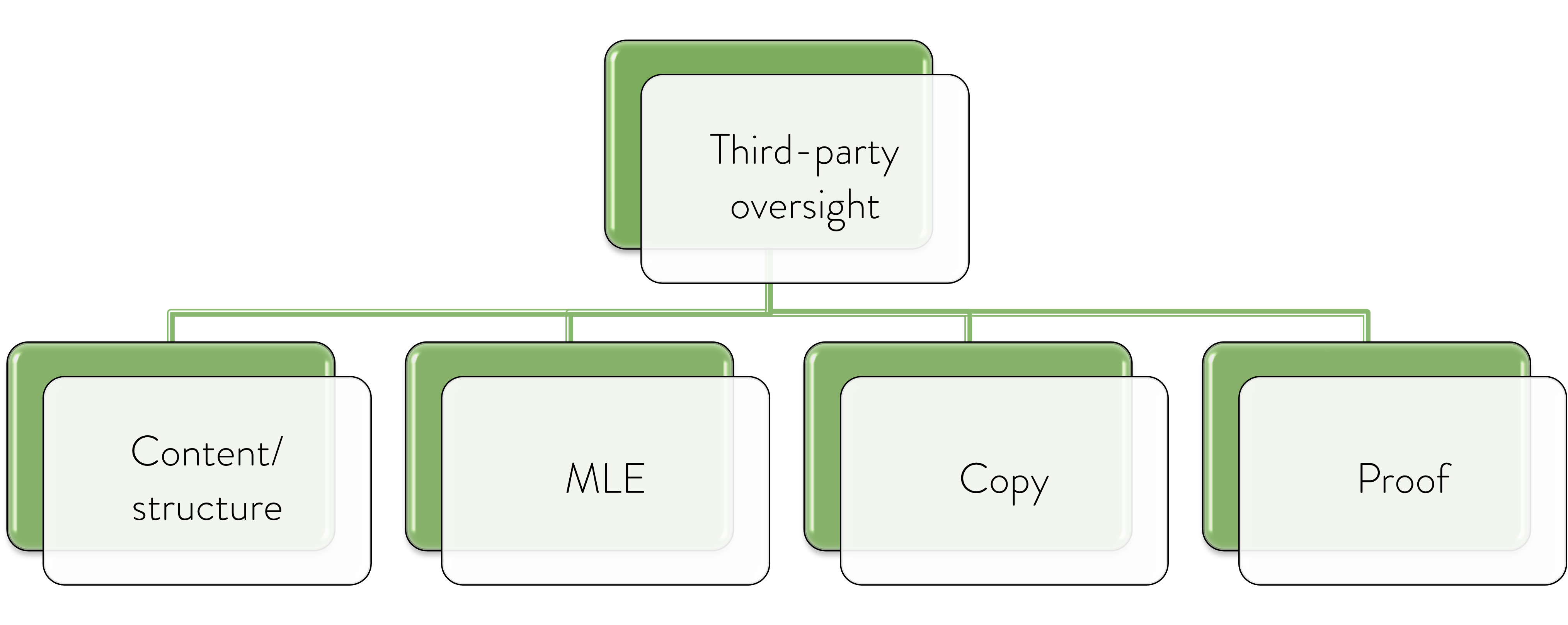
A Smart-Art graphic of the four elements of third-party oversight: content/structure, MLE, Copy, Proof

This part is simple: work with a pro or two. Or three.

Third-party oversight is key to transforming an author-vision first draft into a reader-satisfying second draft. In my firm, we start with thesis/premise, structure, and market placement. If you’re willing to put in the time and can sufficiently distance yourself from your work, you can learn to do that on your own. It ain’t easy, but it’s doable.

A developmental editor can help develop that all-important first draft. Look for someone who understands nonfiction/memoir templates, fiction architecture, and BISAC spread, and who knows how to keep their eye on the content and structure of the manuscript rather than get sidetracked by copy editing/proofing issues.

Once the first draft is finished to your complete satisfaction, find a musical line editor. MLEditors differentiate between narration and editorial, know how to manipulate mechanical and content impact, recognize flavor changes, and can both spot and rectify liability issues. They’ll review the manuscript with you line by line to ensure it has drive, punch, Slinky flow, and auto read.

Once you’re happy with the MLE, pay for a cold-eye copy editor, i.e., “someone sufficiently unfamiliar with the author that they do not ‘hear’ the author’s voice, cadence, accent, or flavor in the back of their head as they read.” Make sure they edit to CMS, not APA, MLA, BlueBook, or AP. Review their corrections carefully — you have the option to reject or discuss anything you don’t agree with or are unsure of.

Finally, pay for a cold-eye proofreader. At that point, your manuscript will have Editorial Accountability.


Claudia Suzanne is a consummate ghostwriter/teacher, understanding what authors need in order to successfully complete their book dream, and she has a finely honed talent for communicating what she knows to her students and clients. Popularly dubbed “The Einstein of Ghostwriting,” Claudia has entertained and informed tens of thousands of writers, editors, journalists, and aspiring authors at countless writer and professional meetings, conferences, radio and BlogTalk radio broadcasts, webinars, and podcasts. Claudia was an invited expert on Penguin’s Author Solutions Expert Video series and a featured entrepreneur in Orange County Business Journal and Norwegian Business Daily. Her signature title, This Business of Books: A Complete Overview of the Industry from Concept through Sales, earned her a 2018 Author of Influence Award from Connected Women of Influence.

Categories: Claudia Suzanne, Ghostwriting, NAIWE Board of Experts

Public Service Announcement: For Educational Purposes Only

Saturday, February Post a comment

I’m the expert who deconstructed ghostwriting theory, skills, and psychology necessary to command premium fees for the work. Most writers who come to me for help are in the same boat.

  • They look for clients but aren’t positioned to attract them
  • They include “ghostwriting” as one of myriad services they provide
  • Their promotion lists their accomplishments: titles written, degrees earned, awards won
  • They willingly share writing samples or do free chapters to demonstrate their skill

Most don’t understand the difference between BISAC spread and BISAC clump. Few can explain the disparate development paths (or potential ROI) between public, purpose, and private titles.

In other words, they present themselves to the world as employees but cannot understand why they’re treated as hirelings. They have no ghostwriting knowledge base. No ghostwriting skills. No ghostwriting authority.

So let me share some facts.

  1. The demand for professional book ghostwriters is higher than the supply. According to industry lore approximately eighty-one percent of Americans want to write a book. That’s 5 million potential authors, conservatively. But of the 54,000 writers in America, only 200 are professional ghostwriters, according to Madeline Morrell of 2M Communications. (I think she’s wrong; I’ve personally trained at least fifty ghostwriters who turned out to be top pros. That said, 283,500,000 : 250 is still a significant demand/supply ratio.)
  2. Pro ghostwriting has been the most profitable career choice for 21st century writers for nearly fifteen years, according to Marty Nemko (US NEWS & WORLD REPORT, 2009).
  3. Professional ghostwriting authority is based on a toolbox of knowledge, skills, and psychology that myriad freelancers admit: “It never occurred to me to even think about knowing something like that.”

To command premium ghostwriting fees, your toolbox must contain:

Book Industry Knowledge Base

  • Industry expectations and standards
  • Industry supply-chain players, discounts, and prospects
  • Traditional vs. hybrid vs. service vs. self publishing
  • Registrations, ownerships, and scam pitfalls

Ghostwriting Theory

  • Scope and limitations
  • Authority and obligations
  • Business vs. freelancing
  • Nonfiction structure, templates, and story
  • Fiction architecture
  • Market vs. audience vs. Amazon
  • Author communication vs. report

Mechanical Skills

  • Editorial
  • Chicago Manual of Style
  • Algorithm-compliance
  • Nonfiction templates
  • Draft sequence
  • Implementation logs

Mechanical/Creative Skills

  • Market positioning
  • Tells, Intent, Perspective
  • Nonfiction charting
  • Fiction mapping
  • Chart to chapter manipulation
  • Map to chapter manipulation
  • Musical Line Editing mechanical elements

Creative Skills

  • Open interviewing
  • Creative Analysis, aka Analytical Reasoning
  • Perspective, Motive, Agenda
  • Plot-PMA integration
  • Meet-in-the-Middle plotting
  • Movel to novel conversion
  • Non-mechanical musical line editing

Creative/Professional Skills

  • BISAC Subject Headings
  • Industry based nonfiction, memoir, and fiction gold and strengths
  • Industry based non-fiction, memoir, and fiction content disruptions and deal breakers

Professional Skills

  • Book proposals
  • Bestseller strategy plans
  • Synopses
  • Query letters

Business Skills

  • Business model
  • Project proposals, aka bids
  • Equitable contracts
  • Business plan
  • Sales funnel
  • Business launch tactics

Ghostwriting Psych

  • Mindset management
  • Human-nature management
  • Project management

Yes, it’s a lot to master, and I truly wish I had a simpler answer for “How do I find clients who will pay me what I’m worth?” But I don’t. Writing can be a job, a paid occupation, or a trade, all of which earns however much the market will bear—but professional ghostwriting is a business that provides premium services at premium prices.

Fortunately, everything in the above list is 100 percent learnable and can be acquired by:

  1. Trial and error, which is the way most pro ghosts learned their profession
  2. Working with a mentor
  3. Taking Ghostwriting Professional Designation Program


Claudia Suzanne is a consummate ghostwriter/teacher, understanding what authors need in order to successfully complete their book dream, and she has a finely honed talent for communicating what she knows to her students and clients. Popularly dubbed “The Einstein of Ghostwriting,” Claudia has entertained and informed tens of thousands of writers, editors, journalists, and aspiring authors at countless writer and professional meetings, conferences, radio and BlogTalk radio broadcasts, webinars, and podcasts. Claudia was an invited expert on Penguin’s Author Solutions Expert Video series and a featured entrepreneur in Orange County Business Journal and Norwegian Business Daily. Her signature title, This Business of Books: A Complete Overview of the Industry from Concept through Sales, earned her a 2018 Author of Influence Award from Connected Women of Influence.

Categories: Claudia Suzanne, Ghostwriting, NAIWE Board of Experts

Passive Voice, Static Voice—What’s All The Fuss About?

Friday, March Post a comment

As writers, we naturally write the way we write naturally. But readers can’t hear the cadence of the words playing out in our heads as our fingers fly across the keys. Readers’ minds merely decipher the little black marks on the page or the pixels on the screen. So “Mom was calling every week; Dad was emailing every day” cannot possibly convey the sense of urgency the author wants to impart because the reader can’t feel it—it’s over, it’s way in the past, it’s a “was.” It’s passive.

Ah, but suppose the line read: “Mom called every week; Dad emailed every day,” with no extra “it’s all over” verb standing between the doer and the deed? Now the reader feels the author’s irritation and can sympathize, snicker, or simply roll their eyes. It’s active.

And “static writing is . . . ?” I hear you ask. Extra words, albeit not necessarily “to be” verbs, that stretch out the sentence or obfuscate its meaning. “I extracted a sample of both of their DNA from the inside of their mouths.”

The line is static: it has no life, it has no energy, it just relays flat, lifeless information. Maybe that’s okay for a textbook or dissertation, but for commercial writing? Ugh.

But suppose the line read: “I extracted DNA samples from inside both their mouths.” Doesn’t that sing a little sweeter? It provides the same information without holding the reader hostage for an extra six words and so pumps the material forward. It’s active.

And that, in 200 little words, is what the passive/static voice fuss is all about!


Claudia Suzanne is a consummate ghostwriter/teacher, understanding what authors need in order to successfully complete their book dream, and she has a finely honed talent for communicating what she knows to her students and clients. Popularly dubbed “The Einstein of Ghostwriting,” Claudia has entertained and informed tens of thousands of writers, editors, journalists, and aspiring authors at countless writer and professional meetings, conferences, radio and BlogTalk radio broadcasts, webinars, and podcasts. Claudia was an invited expert on Penguin’s Author Solutions Expert Video series and a featured entrepreneur in Orange County Business Journal and Norwegian Business Daily. Her signature title, This Business of Books: A Complete Overview of the Industry from Concept through Sales, earned her a 2018 Author of Influence Award from Connected Women of Influence.

Categories: Claudia Suzanne, Ghostwriting, Voice, Writing

Why Do I Teach Ghostwriting Certification Training?

Friday, March Post a comment

That’s what one of my students asked me a couple week ago.

“It can’t make you much money,” she said. “Not for the amount of time and work you put in over the three months.”

She’s right; it doesn’t. I spend three hours a week teaching each class—in the fall, that’s going to go up to four hours/week. My students tell me they put in between 6 and 10 hours on their homework every week—homework that I then have to go over, comment on, discuss, and correct. If I add up everyone’s tuition and divide by the number of hours I put in, I’m making . . .

Damn little.

So why do I teach Ghostwriter Certification Training? Not sure. Let me muse as I write.

If we go back to the beginning, I started teaching the basics of the book business and a little bit about ghostwriting back in 1993, I think. Maybe 1996. Don’t remember. My motive then was to pass on some information and sell my book, This Business of Books: A Complete Overview of the Industry from Concept through Sales, then in its 3rd edition.

Maybe I was looking for referrals. Maybe I just wanted to share. I honestly cannot remember. But I found I enjoyed teaching. It was fun. It was stimulating. It was educational for me. And people paid me a little bit of money. A win/win.

Over the years, the class ebbed and flowed. I taught sometimes, didn’t the rest. Tried to put together Professional Book Writing School, but life got in my way. Remember, I spent over two decades struggling with serious health problems, which I have now, Baruch Ha’Shem, completely overcome. But during most of the past two decades, I was inconsistent and intermittent with my work habits, my clients, and my teaching.

Looking back, it’s amazing to me how much I managed to get done by just bulldozing through. When faced with allegedly insurmountable odds, some people take it easy, some people rely on the medical community, and some people give up. I just put my head down and worked. Not fast, not always well, but through the best and the worst of it, I worked.

And then I was facing the end.

It was 2000 and I had one of those “life-changing” episodes during a downward health spiral that told me I was coming to the end of my days. But I had a client! How could I transition to the next world and leave my client up in the air? So I handed the client over to one of my interns and started pricing funerals.

I won’t keep you in suspense—I didn’t die. In fact, with the help of my beautiful sister-by-love, Bera Dordoni, N.D. (Bastis Foundation), I began the long journey back to perfect and total health. But it was an eye-opening experience and I realized I had to write a book. And so I did.

And I rewrote it.

And rewrote it.

And so and so forth and scooby dooby do.

The final edition of said book, Secrets of a Ghostwriter: World’s First Step-by-Step Guide to the Theory, Skills, and Politics of Ghostwriting, is at long last complete and exhaustively emended by five wonderful, nit-picky editors. And Ghostwriter Certification Training has evolved from a 5-week to a 7-week to a 14-week and soon to be 16-week program that details exactly what the job is, how to do the job, how to find aspiring authors to do the job for, and how to convert those authors into contracted clients.

Which may be the actual reason why I continue to teach Ghostwriter Certification Training. After putting in all this time and effort to develop what Cora Foerstner called “the seminal text” on the subject and honing the program to the point that I’m confident it’s turning out skilled, competent ghostwriters, how can I stop?

But I warn you now, the price is going up. Because yeah—I don’t make enough money at this right now!


Claudia Suzanne is a consummate ghostwriter/teacher, understanding what authors need in order to successfully complete their book dream, and she has a finely honed talent for communicating what she knows to her students and clients. Popularly dubbed “The Einstein of Ghostwriting,” Claudia has entertained and informed tens of thousands of writers, editors, journalists, and aspiring authors at countless writer and professional meetings, conferences, radio and BlogTalk radio broadcasts, webinars, and podcasts. Claudia was an invited expert on Penguin’s Author Solutions Expert Video series and a featured entrepreneur in Orange County Business Journal and Norwegian Business Daily. Her signature title, This Business of Books: A Complete Overview of the Industry from Concept through Sales, earned her a 2018 Author of Influence Award from Connected Women of Influence.

Categories: Claudia Suzanne, Ghostwriting, Writing

  • 1
  • 2
  • Next Page »

Recent Posts

  • Beyond Writing: How Expanding Your Services Can Strengthen Your Freelance Business
  • Am I a Writer or Not?
  • Be Prepared for That Crisis Moment When You Need Business Backup
  • Stick with Your System
  • In a Pricing Rut? Try These 3 Strategies

Categories

Meta

  • Log in
  • Entries feed
  • Comments feed
  • WordPress.org

Latest Posts

Beyond Writing: How Expanding Your Services Can Strengthen Your Freelance Business

July 22, 2026

Am I a Writer or Not?

July 16, 2026

Be Prepared for That Crisis Moment When You Need Business Backup

June 30, 2026

Stick with Your System

June 29, 2026

In a Pricing Rut? Try These 3 Strategies

June 25, 2026

Improving Your Vision

June 24, 2026

Contact Us

  • 804-476-4484
  • P.O. Box 412
    Montpelier, VA 23192-0412
Facebook Instagram Linkedin twitter

© NAIWE. All rights reserved. Designed by My House of Design.